Reaction wheels turn a spacecraft by exchanging angular momentum with its body. An electric motor changes a wheel’s spin, and the spacecraft responds with a rotation in the opposite sense. No propellant has to be expelled for that maneuver, but the wheel cannot absorb angular momentum indefinitely.
This is attitude control: changing where a spacecraft points. It is different from changing the path of its center of mass through space.
The motor acts on both the wheel and the spacecraft
A reaction wheel is mounted inside the spacecraft. When its motor applies torque to the wheel, the mounting applies an opposite torque to the spacecraft body. With no external torque, the total angular momentum of the combined system remains constant.
NASA’s onboard-systems guide describes this exchange as a way to achieve three-axis stabilization. Several appropriately oriented wheels let the control system combine torques to adjust the spacecraft’s orientation in different directions.
The key action is changing the wheel’s angular momentum. A wheel spinning steadily is not continually accelerating the spacecraft into an ever-faster turn. And a spacecraft does not need to push against air to rotate: the motor and the rest of the vehicle act on one another.
How can it turn and then stop?
Consider an idealized one-axis maneuver, starting with both the spacecraft body and its wheel at rest. Ignore external torques. Accelerating the wheel clockwise makes the body begin rotating counterclockwise, with angular momentum balancing between the two.
To end the turn, the controller applies torque in the other sense. In this simple example, braking the wheel back to rest also brings the body back to rest. The spacecraft has reached a new orientation because it rotated during the interval between acceleration and braking.
Real systems may keep their wheels spinning at a bias speed, and maneuvers need carefully timed control. The example explains the exchange; it is not flight software or a requirement that every operational wheel stop after each maneuver.
Why a wheel eventually needs unloading
Spacecraft experience external torques, including disturbances from sunlight or their environment. Holding the body pointed steadily can require the wheels to absorb that added angular momentum. Their speeds can then approach operating limits.
NASA’s small-spacecraft guidance and control reference distinguishes torque capability from momentum storage. Once a wheel reaches a speed limit, it cannot keep accepting momentum in that direction. This saturation is a control limit, not necessarily a broken motor or an empty battery.
Unloading requires an external torque on the combined spacecraft-and-wheel system while the wheels are brought toward a more useful operating range. Thrusters can provide that torque. Near Earth, magnetic torquers can interact with the planet’s magnetic field. Simply commanding the wheel to slow down without such an interaction transfers momentum back to the body instead of removing it from the overall system.
Hubble shows why sensors and actuators are different
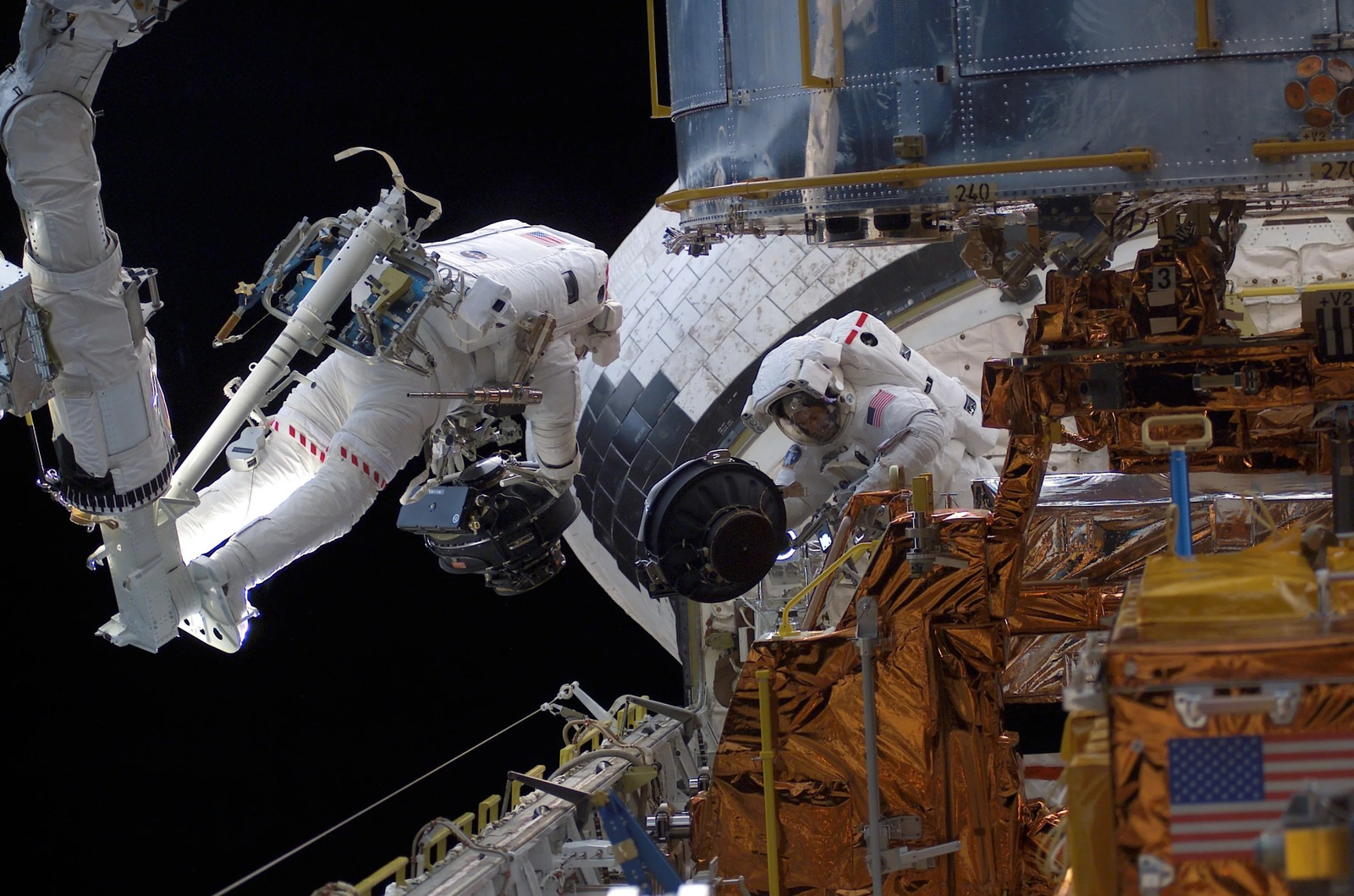
NASA’s description of Hubble’s pointing control separates two hardware roles. Sensors supply information about orientation or rotation; actuators physically change the telescope’s pointing. Hubble uses reaction wheels for rotation and magnetic torquers for momentum management, avoiding propulsion exhaust that could contaminate its sensitive optics.
A gyroscope used as a rate sensor is therefore not interchangeable with a reaction wheel. The gyro helps answer “How are we rotating?” The wheel responds to the controller’s instruction to change that rotation. Star-based sensors provide other pointing information, helping the system compare where it is aimed with where it should be aimed.
That separation also helps interpret mission news. A sensor problem and a wheel failure affect different parts of the control loop, even if both can interfere with observations. The words “gyroscope” and “reaction wheel” should not be used as synonyms.
Can reaction wheels send a spacecraft toward another planet?
Internal wheel torques do not provide sustained thrust to change the trajectory of the spacecraft’s center of mass. They can help point an engine or antenna in the right direction, but an orbital insertion burn requires a different kind of maneuver.
Reaction wheels solve the pointing problem through controlled internal rotation. Propulsion handles changes in translational motion, while momentum unloading keeps the pointing system within its limits. Knowing which of those jobs is being discussed makes spacecraft operations much easier to follow.