A galaxy can have a bright catalog magnitude and still be difficult to see because that number adds up light spread across its whole image. Surface brightness measures light per unit angular area. Spreading the same total light over a larger patch makes each part fainter, even though the integrated magnitude stays the same.
That distinction explains why a galaxy and a star with the same apparent magnitude are very different observing targets. It also helps explain why the center of a galaxy can stand out while its outer disk disappears into the sky background.
Total light and light per patch answer different questions
Integrated apparent magnitude measures the combined flux received from an object in a specified wavelength band. Surface brightness describes how that flux is distributed across the sky, commonly in magnitudes per square arcsecond. An arcsecond is 1/3,600 of a degree; a square arcsecond is an angular area.
As with ordinary magnitudes, a larger surface-brightness number means fainter light per area. A value of 24 magnitudes per square arcsecond is fainter than 22 in the same band and measurement system. Our guide to apparent and absolute magnitude explains why magnitude numbers run in that direction.
Case Western Reserve University's galaxy-photometry notes distinguish total flux from its distribution. A galaxy's center, disk, and outer regions need not share one surface brightness.
Calculate the average for a hypothetical galaxy
For integrated magnitude m measured over angular area A, the mean surface brightness is:
Mean surface brightness = m + 2.5 log10(A), with A expressed numerically in square arcseconds when the answer is in magnitudes per square arcsecond.
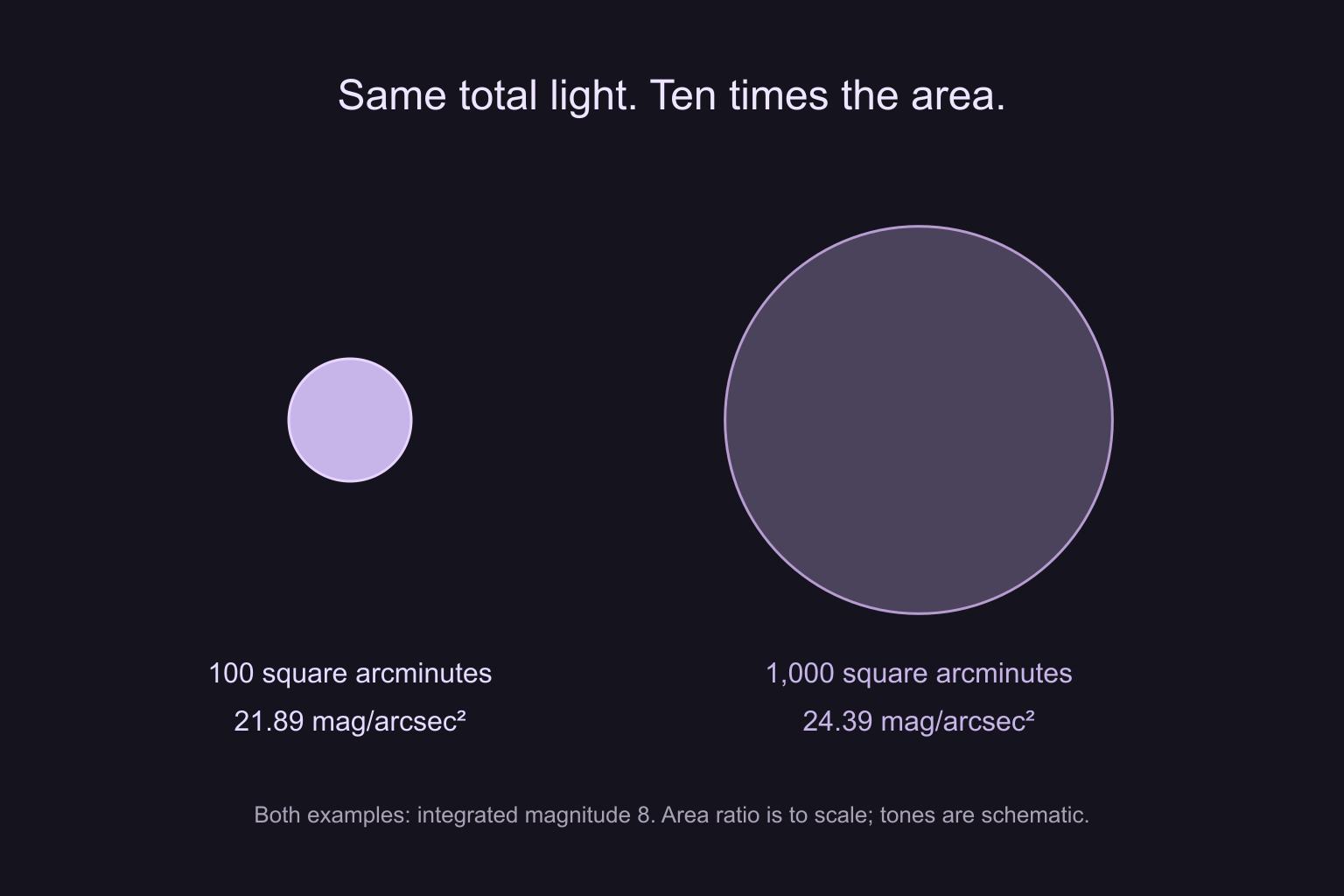
Suppose a hypothetical galaxy has magnitude 8 within an area of 100 square arcminutes. Because one square arcminute contains 3,600 square arcseconds, the area is 360,000 square arcseconds. The calculation is 8 + 2.5 log10(360,000), giving approximately 21.89 magnitudes per square arcsecond.
Now spread exactly the same total light across ten times that area. The integrated magnitude remains 8, but the mean surface brightness becomes 24.39 magnitudes per square arcsecond: 2.5 magnitudes fainter, or one-tenth as much light per area.
These are invented teaching examples, not measurements of two named galaxies. They isolate the effect of angular area. The GNU Astronomy Utilities documentation gives the flux, magnitude, and surface-brightness relationships underlying the calculation.
Why one average cannot predict the whole view
An average depends on the region used to measure it. Including a broad, faint outer disk produces a different mean from measuring only the bright center. The magnitude and area in the calculation must describe the same region; combining a total magnitude from one catalog with an unrelated diameter can mislead.
A centrally concentrated galaxy and a nearly uniform patch can therefore have the same mean surface brightness but different visible features. Likewise, a faint-looking outer structure can be real even when the central region is easy to detect.
The Open University's introduction to photometry explains another essential step: estimating and subtracting the background. A measurement includes sky light as well as the target's light. Surface brightness is useful precisely because detecting extended structure depends on separating those contributions, not simply collecting a large total number of photons.
Does moving a galaxy farther away lower its surface brightness?
In a simple nearby-universe calculation, doubling a galaxy's distance reduces its received flux to one-quarter. Its angular area also becomes one-quarter as large. Dividing flux by angular area leaves the same surface brightness, provided the structure remains resolved.
This result assumes unchanged emission, no intervening absorption, and negligible cosmological effects. It is not a rule that every distant galaxy is equally easy to observe. Angular detail becomes harder to resolve, and cosmological redshift and dimming matter over large distances.
How to use a galaxy listing
Read the integrated magnitude together with angular size, wavelength band, and any available brightness profile. A central surface brightness and a mean within a stated radius are different quantities. Neither supplies a universal visibility threshold for every telescope and sky.
For visual observing, the target's contrast against the sky and the image scale both matter. Our aperture guide explains the related role of light collection and exit pupil. Surface brightness adds the missing question to a catalog magnitude: how widely is that light spread?