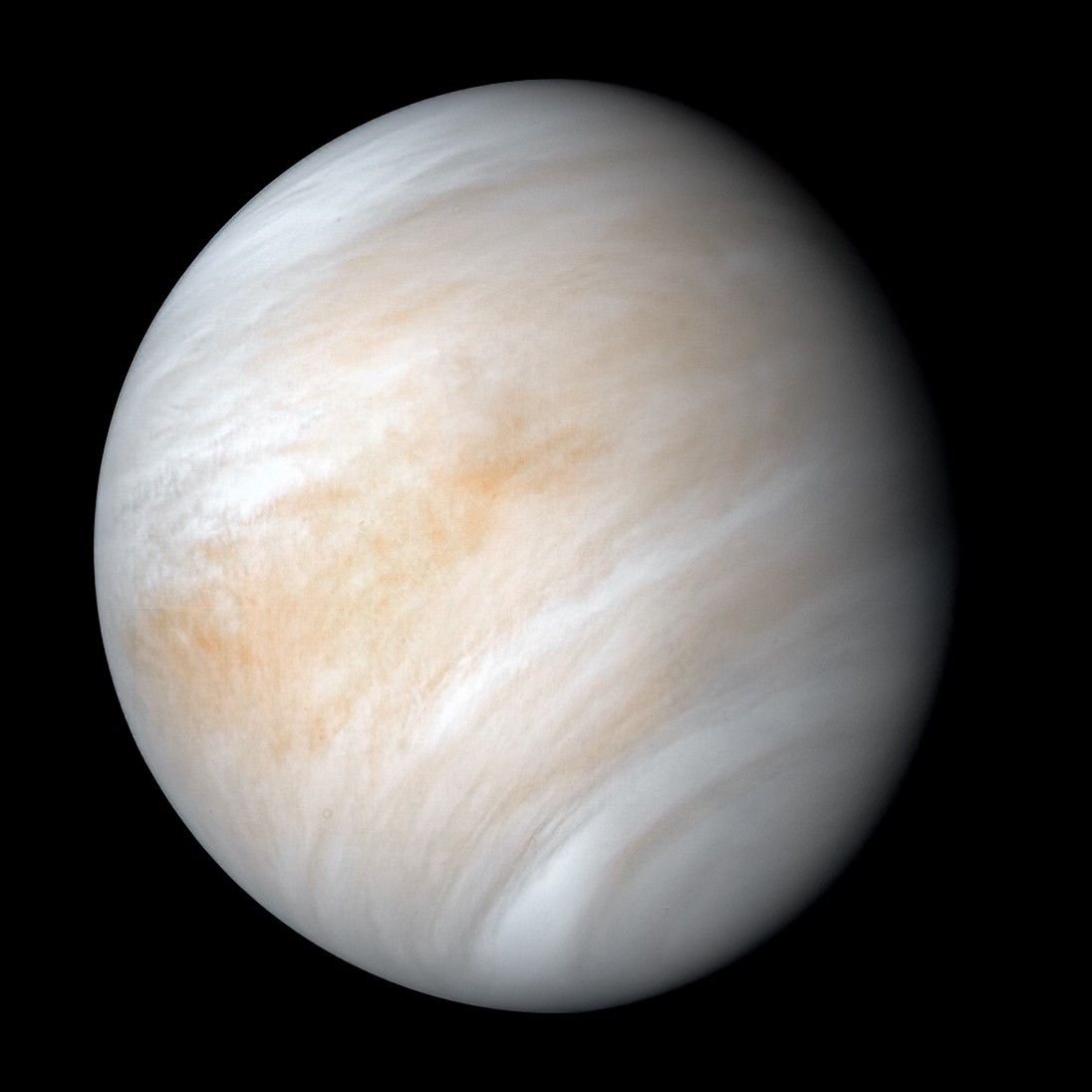
A day on Venus lasts about 243 Earth days when measured by the planet’s rotation relative to the stars, but about 117 Earth days when measured from one solar noon to the next. Both values are correct. They describe different cycles, which NASA distinguishes as the sidereal day and solar day.
The familiar statement that a day on Venus lasts longer than its year needs that distinction. Venus takes about 225 Earth days to orbit the Sun. Its rotation takes longer than its year; its solar day does not.
Two clocks, two different questions
A sidereal day measures one complete turn relative to distant stars. Imagine a marker fixed to the planet: this clock follows how long it takes the marker’s direction to rotate through a full circle in space.
A solar day follows the Sun’s apparent position in the local sky. Solar noon to solar noon is a useful definition because it does not depend on whether clouds or a mountain hide a sunrise.
The clocks differ on Earth, too. One rotation takes roughly 23 hours and 56 minutes, while the average solar day lasts 24 hours. NASA’s explanation of planetary day lengths introduces the distinction. A planet travels along its orbit while it spins, so turning once relative to the stars does not necessarily bring the Sun back to the same place in its sky.
Why Venus’s backward spin matters
Venus rotates in the opposite sense to its motion around the Sun. This is called retrograde rotation. It does not mean Venus travels backward around the Sun.
Its rotation and orbital motion combine to move the Sun through the local sky faster than rotation alone would. In the idealized surface view, the Sun rises in the west and sets in the east. NASA’s Venus overview for Space Place describes this reversed sequence and the approximately 117-day interval between sunrises.
Where the 117-day number comes from
Using rounded periods, Venus spins through about 360 / 243 = 1.48 degrees per Earth day relative to the stars. It moves around its orbit at an average rate of about 360 / 225 = 1.60 degrees per Earth day.
Because the spin is retrograde, these rates add when calculating the Sun’s apparent daily circuit:
Solar-day length ≈ 360 / (1.48 + 1.60) ≈ 117 Earth days.
This is an illustrative calculation using uniform motion and rounded values, not a prediction of a particular sunrise. The calculation uses the rotation and orbital periods in NASA’s Venus summary; JPL’s planetary parameter table also records Venus’s retrograde sidereal rotation.
The result explains why a sunrise clock can complete a cycle before the planet has turned once relative to the stars. The direction to the Sun changes as Venus moves along its orbit.
Does the rotation always take exactly 243 days?
No. The familiar number is rounded, and Venus’s spin rate varies. A 2021 radar study by Jean-Luc Margot and colleagues found an average sidereal period of 243.0226 Earth days for observations spanning 2006–2020, with variations of roughly 20 minutes.
Those measurements refine the rotation period. They do not explain the much larger difference between 243 and 117 days; that difference comes from using two different reference frames.
Is a solar day the same as daylight?
No. A complete solar day includes both the daytime and nighttime portions of the cycle. Sunrise to sunset covers only the daylight portion, so it should not be substituted for the 117-day sunrise-to-sunrise interval.
For a separate question about Venus—why it appears as a crescent from Earth—our guide to planetary phases explains the viewing geometry.