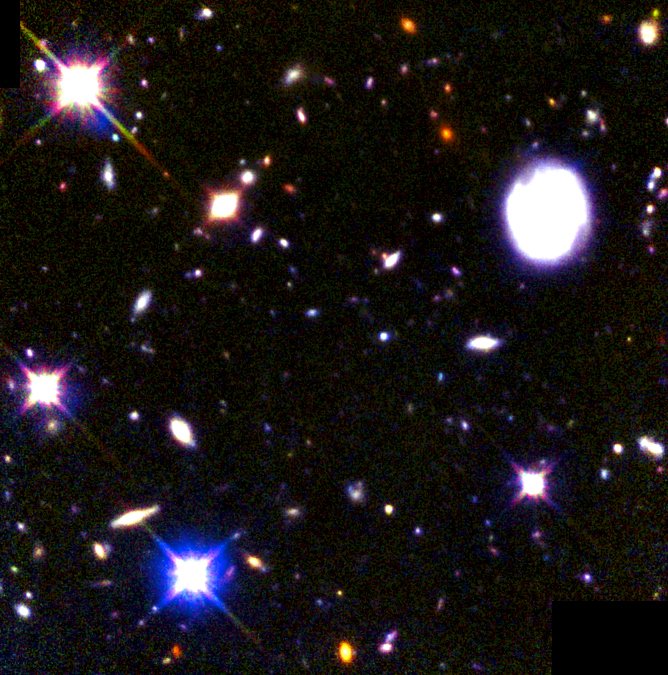
Galaxy colors contain useful clues, but a red galaxy is not automatically an old galaxy. Its appearance can reflect its stars, intervening dust, the stretching of light during its journey, and the way telescope data are displayed. NASA’s Hubble Deep Field South image notes explicitly describe several of these explanations for red-looking galaxies in the same image.
Before assigning an age to a colored patch in a space photograph, ask what produced that color and what the image actually measures.
What the stars can tell us
A galaxy’s light combines the contributions of many stars. A population with abundant luminous, young blue stars can look bluer than one whose light is dominated by older stars. That connection makes color useful for investigating a galaxy’s history of star formation. ESO’s explanation of changing stellar populations describes how those populations affect the light galaxies emit.
The important word is population. A galaxy is not a single star with a single birthday. Nor does an individual red star have to be old: low-mass stars can be cool and red, while some massive stars become red supergiants late in their lives. ESA’s Gaia color explainer connects stellar color with temperature, mass, and evolutionary stage.
A broad color therefore gives a clue about the mixture supplying the light, not a complete age record for everything in the galaxy.
Dust can make starlight look redder
Interstellar dust obscures some of the light traveling toward us. It suppresses blue light more strongly than red light, so the light that reaches the telescope can look redder than it did before passing through the dust.
ESA’s Gaia sky map provides an example within our own galaxy: dusty regions near the Galactic Center appear reddened. The stars have not all changed temperature because our line of sight crosses a dust cloud.
For another galaxy, this creates an ambiguity. Red-looking light can indicate an older stellar population, but it can also indicate obscuration. Color alone does not decide between those explanations.
Distant young galaxies can look red
The expansion of the universe stretches light to longer wavelengths. This cosmological redshift changes which wavelengths reach a telescope compared with those originally emitted.
In the Hubble Ultra Deep Field, some small red objects are distant galaxies undergoing substantial star formation. They appear red because their light has shifted toward infrared wavelengths. NASA’s Ultra Deep Field explanation makes the contrast explicit: an object can be forming stars energetically and still look red in the displayed image.
To compare stellar populations fairly, astronomers must account for that wavelength shift. Otherwise, they risk comparing different parts of the galaxies’ emitted light.
A displayed color also depends on the image recipe
Astronomical images often combine observations through several filters. The displayed red, green, and blue channels may represent wavelengths our eyes cannot see.
For example, the Hubble Deep Field South composite assigns infrared observations to its red and green channels and visible-light observations to blue. A red feature in that picture is therefore not a straightforward preview of what an astronaut would see.
When reading a galaxy image, check three things: which wavelengths were observed, how they were mapped to display colors, and what additional evidence supports the caption’s interpretation. If those details are absent, treat an age estimate based only on appearance cautiously.
Our guide to space observation technology explains how instruments turn light into astronomical data. For interpreting galaxy colors, that measurement context is as important as the colors themselves.