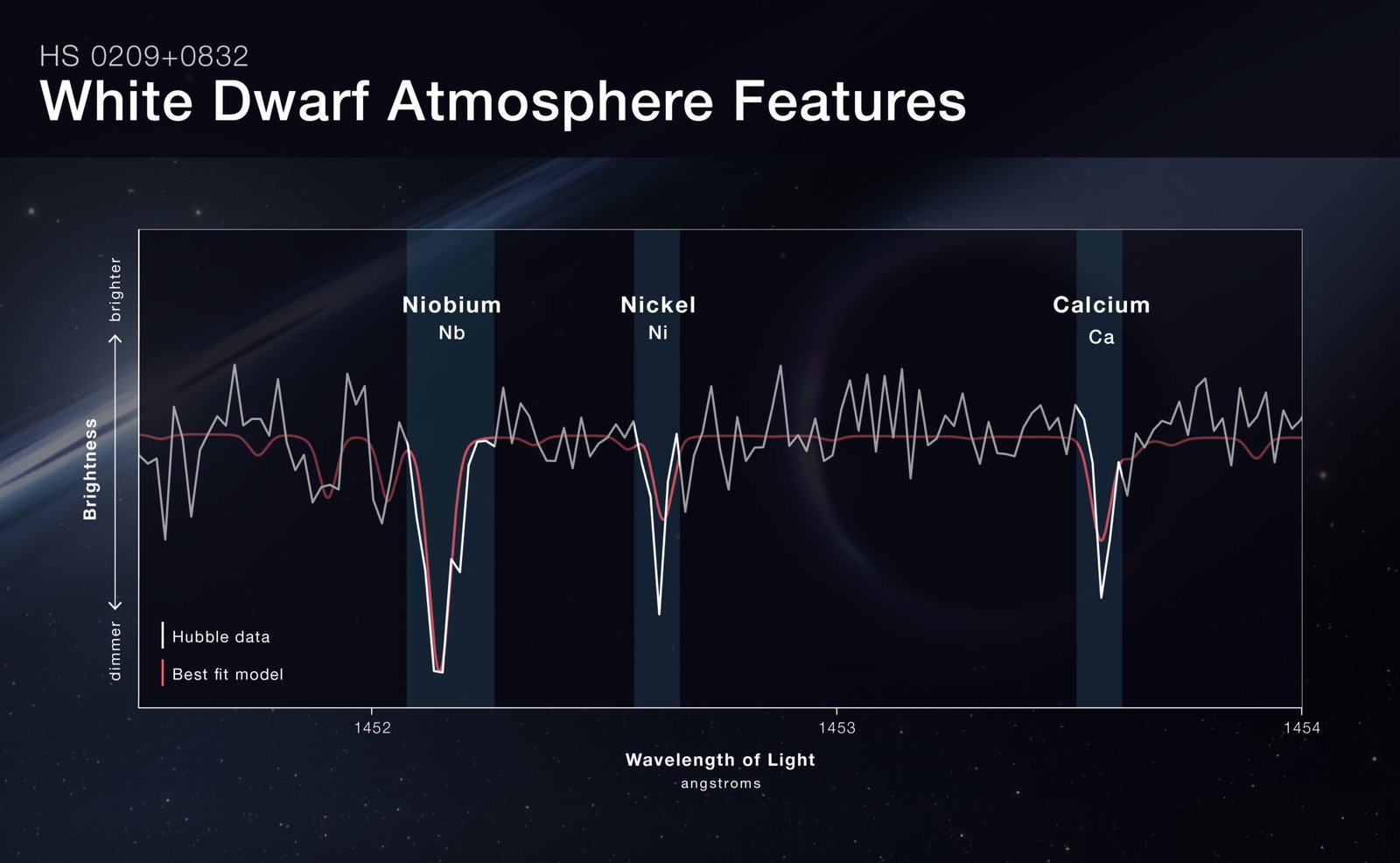
A new analysis of archival Hubble observations points to a possible planet made from material shed by a dying star. The candidate around the white dwarf HS 0209+0832 is inferred from unusual chemistry and repeating brightness variations; it has not been established by a direct photograph of a planet.
The study, led by Jamie T. Williams at the University of Warwick, was published in Nature Astronomy on October 5, 2026. NASA's announcement describes a potential second generation of planetary material, rather than an ordinary planet simply surviving its star's earlier life.
The new clue was hiding in older observations
Hubble observed the white dwarf in 1999, but roughly 100 spectral features remained unidentified in the earlier analysis. Revisiting the observations with more complete atomic information allowed the researchers to identify many of those features with copper and niobium.
A spectrum separates light by wavelength. Absorption features show where atoms or ions remove light, while models help turn their patterns into estimates of composition. Our spectrograph explainer describes why recognizing a line and measuring an abundance are separate tasks.
NASA reports that data from the retired Far Ultraviolet Spectroscopic Explorer also support the niobium identification. That is a second instrument's evidence about the chemistry, not a second independent discovery of the proposed planet.
Why that chemistry suggests a different origin
Many white dwarfs show evidence of material falling onto them from disrupted planetary bodies. The unusual feature here is the composition of that material: the researchers find enrichment in elements heavier than iron, including niobium, alongside a shortage of familiar rock-forming ingredients.
In the research paper, the team compares that pattern with material expected from a star's late giant phase. Certain heavy-element abundances fit material processed during that stage better than ordinary Solar System-like debris.
The proposed sequence is that the star shed enriched material, some remained in a disk, and a giant planet formed or acquired material there. Radiation from the hot white dwarf could now strip the planet's atmosphere, feeding some of it back toward the star. This is the team's physical interpretation connecting the observations; Hubble did not watch the entire sequence occur.
What the repeating signal adds
TESS observations reveal a brightness modulation repeating approximately every 4.4 days. The study considers light varying as different parts of an irradiated planet come into view, or an evaporating planet's trailing material crossing the line of sight.
The University of Warwick's release explains why a close-orbiting gas giant is a plausible interpretation. The periodicity supplies another constraint alongside the chemical evidence. It should not be described as an unambiguous photograph, a measured planetary surface, or an ordinary transit with a uniquely determined planet size.
The release also discusses the difficulty of retaining expelled stellar material in a disk. A former companion could have helped shape that material, but this part of the proposed history still needs testing.
What remains uncertain
The paper does not settle every detail of the object's origin. One possibility it discusses is a first-generation core acquiring a second-generation atmosphere, rather than an entirely new planet forming from scratch. That distinction matters when interpreting phrases such as “reborn planet.”
Additional modeling is needed to connect the unusual abundances to the composition of the escaping material. More observations can test the origin of the repeating signal and the proposed mass loss. The evidence makes this system a compelling candidate; it does not yet provide a census of how common such systems are.
The ESA/Hubble account reports the same study and shares much of NASA's release. It is useful mission context, not an independent confirmation. Its dramatic artist's concept likewise represents a hypothesis, not resolved imaging of the candidate.
Why the result matters without overturning ordinary planet formation
Planets forming in disks around young stars and planets incorporating material shed much later are different formation histories. Evidence for the latter would extend the range of environments where planetary material can assemble; it would not invalidate the former.
Our white-dwarf history guide explains how a remnant's atmosphere can retain clues to later accretion. In this case, the useful advance is a specific, testable chemical clue to an unusual history. The question now is whether further evidence supports the candidate and clarifies how it formed.