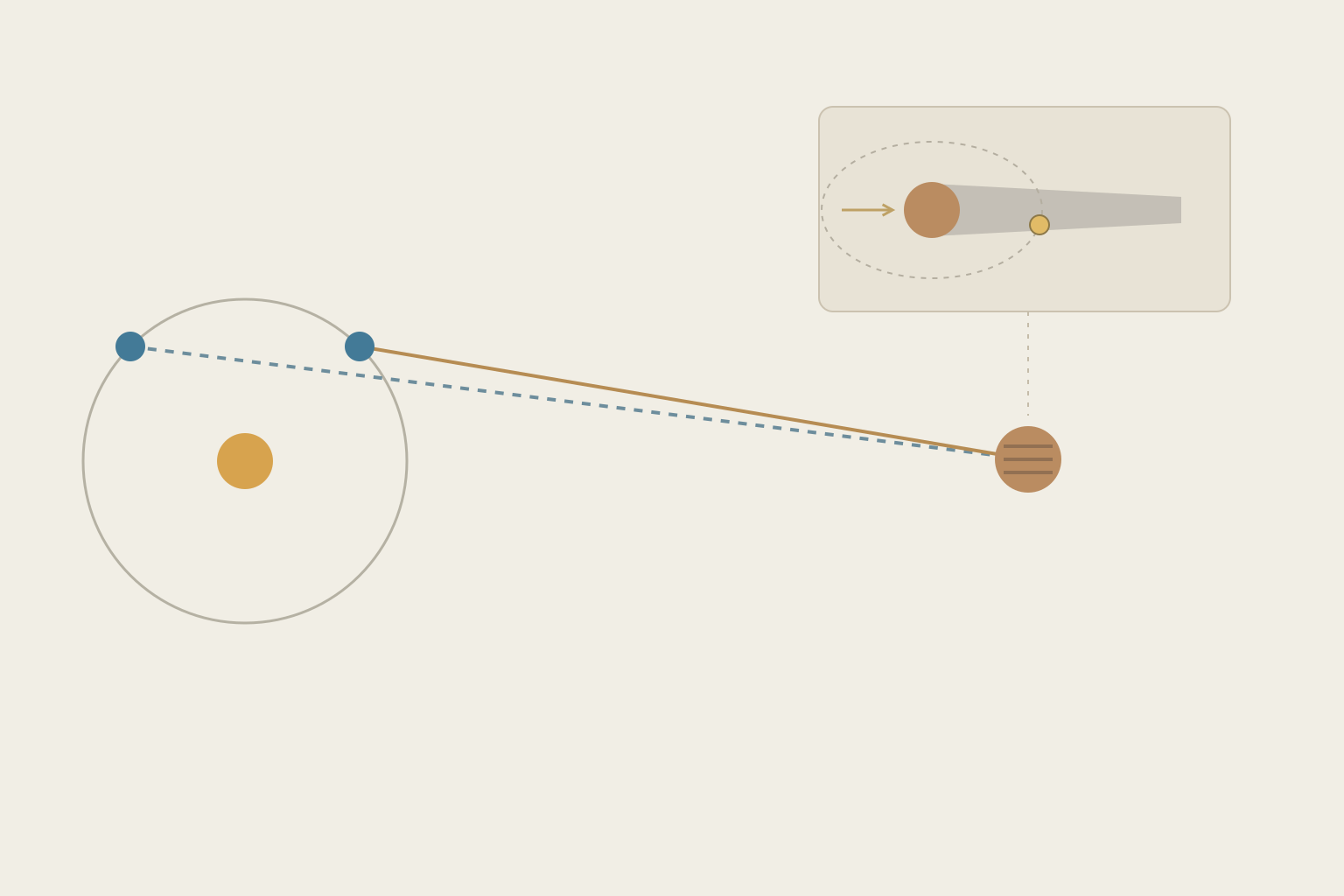
The connection between Io and the speed of light came from a mismatch in eclipse timings. In 1676, Ole Rømer argued that light took time to travel from Jupiter’s moon to Earth. As the Earth–Jupiter distance changed, the same kind of event appeared earlier or later than a simple timetable predicted.
The crucial insight was that an observed time contains two things: when an event happened and how long its light took to reach the observer.
A moon became a distant clock
Io, the innermost of Jupiter’s four large Galilean moons, completes an orbit in about 1.77 Earth days. It repeatedly passes through Jupiter’s shadow. Tracking its disappearance into shadow or emergence from it gives astronomers a recurring event to time.
This is an eclipse of Io, not merely the moon passing behind Jupiter’s visible disk. Distinguishing the shadow from the planet matters when explaining what observers were timing.
As the American Museum of Natural History’s account explains, these observations also had a practical motivation. Tables of Jupiter’s satellites offered a possible common clock for comparing times at different locations and determining longitude. The timing discrepancies became evidence about light itself.
A longer path produces a later arrival
When Earth’s motion increases its distance from Jupiter, light from a later eclipse must cross more space. The observed interval between comparable events can therefore lengthen. When the distance decreases, that effect reverses.
Rømer’s argument used the accumulating pattern over many observations, not a single late eclipse. The Paris Observatory’s historical account places his work alongside Cassini’s observations and tables. It also records disagreement over whether light-travel time or irregularities in the moon’s motion explained the discrepancies.
This is a concrete example of prediction and physical explanation playing different roles: a timetable can expose a regular mismatch before its cause is understood.
The clock and the delivery delay are separate
Write the relationship as arrival time = event time + light-travel time. When comparing two eclipses, the observed interval includes the difference between their travel times. A fixed travel delay shifts both timestamps equally; a changing delay alters their apparent spacing.
As a hypothetical example, if successive signals take 500 and 502 seconds to arrive, the observed interval is two seconds longer than the interval between their emission. Those numbers are not Io measurements. They isolate the effect that the changing Earth–Jupiter distance contributes to an eclipse timetable, alongside the orbital motion that astronomers also have to model.
Put the delay on a familiar scale
Using modern rounded values, light takes about 499 seconds—8 minutes 19 seconds—to cross one astronomical unit, the approximate Earth–Sun distance:
149.6 million kilometers ÷ 299,792 kilometers per second ≈ 499 seconds.
An extra path of two AU would add about 16 minutes 38 seconds. This is an illustrative calculation using modern values, not a reconstruction of Rømer’s original measurement or the delay in every pair of Io eclipses. Real Earth–Jupiter geometry changes continuously, and Jupiter moves too.
NASA’s solar-system constants provide the distance and light-speed values used in this calculation.
What Rømer established
Rømer’s lasting result was the evidence that light propagation takes a finite time. Assigning him today’s precise numerical speed would misstate the history. The Paris Observatory records an early estimate of 10–11 minutes for light to cross Earth’s orbital radius and distinguishes Rømer’s argument from Huygens’ subsequent calculation of a speed.
Modern astronomy routinely separates emission time from arrival time. Looking at Io, a nearby star, or a distant galaxy means receiving information after a travel delay. Rømer’s work made that delay a measurable part of astronomy rather than an invisible assumption.