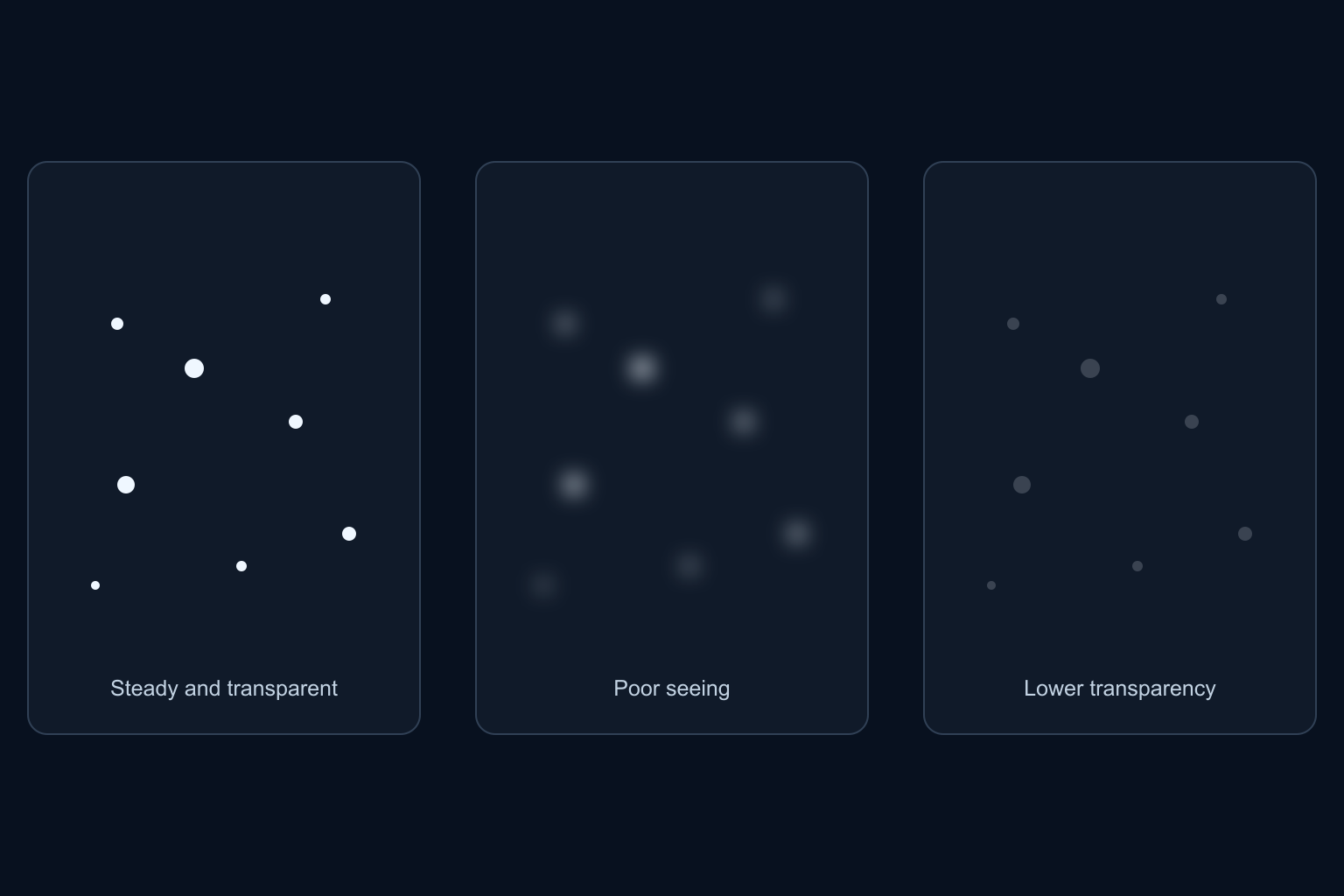
Seeing and transparency describe different limits on an astronomical view. Seeing is the steadiness of the atmosphere; transparency describes how well light passes through it. A cloudless night can reveal faint stars while turbulent air smears the details of Jupiter. Another night can offer steady planetary views through a slight haze.
Separating the two helps you choose a target and diagnose a disappointing image before changing equipment. Sky brightness is a third consideration: a transparent sky can still be bright with moonlight or artificial light.
What poor seeing does to an image
Moving air with different temperatures and densities changes how starlight travels through the atmosphere. A star's image can dance, spread out, or briefly sharpen. Fine lunar and planetary features can appear to ripple. More magnification enlarges that disturbed image without recovering the detail the atmosphere has blurred.
ESO's explanation of adaptive optics describes how professional telescopes measure these disturbances and compensate with rapidly changing mirrors. That correction addresses distorted incoming light. It does not remove clouds or turn a bright sky dark.
Observatories often express seeing in arcseconds, an angular measure. Smaller values indicate narrower atmospheric blurring under specified conditions. ESO's observing-condition guide distinguishes reference seeing from the final image quality at a telescope: wavelength, target elevation, and instrumental effects matter too. A forecast number is not a guarantee of the view through your eyepiece.
What poor transparency changes
Cloud, haze, and airborne particles can reduce the light reaching you and scatter light into the background. Faint extensions of a galaxy may become difficult to distinguish even while a bright planet has a relatively steady outline.
Richard S. Wright Jr.'s observing account in Sky & Telescope illustrates why observers evaluate transparency separately from seeing. His practical distinction is useful; local experiences and forecasts should still be checked against conditions at your own site.
Humidity alone is not a complete transparency measurement. Nor does counting the stars you can see isolate transparency: moonlight, light pollution, dark adaptation, and your eyesight also change that count. Compare the same part of the sky under reasonably similar conditions rather than treating one missing faint star as a precise atmospheric test.
Choose a target that fits the conditions
Steady air with reduced transparency: bright lunar features, Jupiter, or Saturn may remain useful targets. The atmosphere can transmit less light without constantly shifting the finest details. Thick cloud can still make observing impractical.
Unsteady air with good transparency: try a wider view of an open cluster or the larger structure of a deep-sky object. Resolving a tight double star or small planetary feature is likely to be more frustrating. Faint-object work also needs a sufficiently dark background.
Steady, transparent air with a bright Moon: planetary detail may be excellent while a faint galaxy has poor contrast. The mismatch does not mean the seeing forecast failed; the targets demand different conditions.
Treat these scenarios as starting points; conditions can change during the night. Use a moderate magnification first, then increase it only while the view gains useful detail.
Check the telescope before blaming the sky
An image that changes from moment to moment suggests moving air, but that air may be close to the instrument. A warm telescope, a nearby roof, or a heated surface can complicate the view. As the Celestron observing manual advises, allow the instrument to approach outdoor temperature, check focus and alignment as appropriate, and avoid observing across obvious sources of rising warm air when possible.
A Bahtinov mask helps establish focus; it cannot stabilize the atmosphere. Likewise, a larger telescope aperture raises the instrument's potential resolution but does not ensure the sky lets you use it.
For a useful observing log, record the target and its elevation, magnification, image steadiness, haze or cloud, and background brightness separately. “Clear but Jupiter kept rippling” preserves more information than “bad sky.” Over several sessions, those distinctions make it easier to decide whether to change the setup, change the target, or return under different conditions.