A salty liquid on Mars would not automatically be habitable. Dissolved salts can help water remain liquid at lower temperatures, but a brine must also provide water that organisms can use, at temperatures and chemical conditions compatible with their biology. Those requirements have to be met together.
This makes the question more demanding than “could liquid form?” A model can permit a brief liquid phase without showing an environment in which known terrestrial organisms could grow or reproduce.
Salt can help a liquid persist and make life harder
A brine is water containing dissolved salts. Depending on composition and concentration, salts lower the freezing temperature and alter evaporation behavior. That makes some brines more plausible than pure liquid water under cold, low-pressure Martian surface conditions.
But remaining liquid is a physical property, not a biological verdict. Concentrated salts alter the water's chemical availability and can impose additional stresses on cells. Different salts cannot be treated as interchangeable simply because both solutions are liquid.
Chevrier and Slank's 2024 perspective on Martian brines reviews the interplay between formation, persistence, and habitability. It emphasizes how the surface environment restricts where, when, and how much brine might form. The discussion does not establish an inhabited Martian pool.
What water activity means
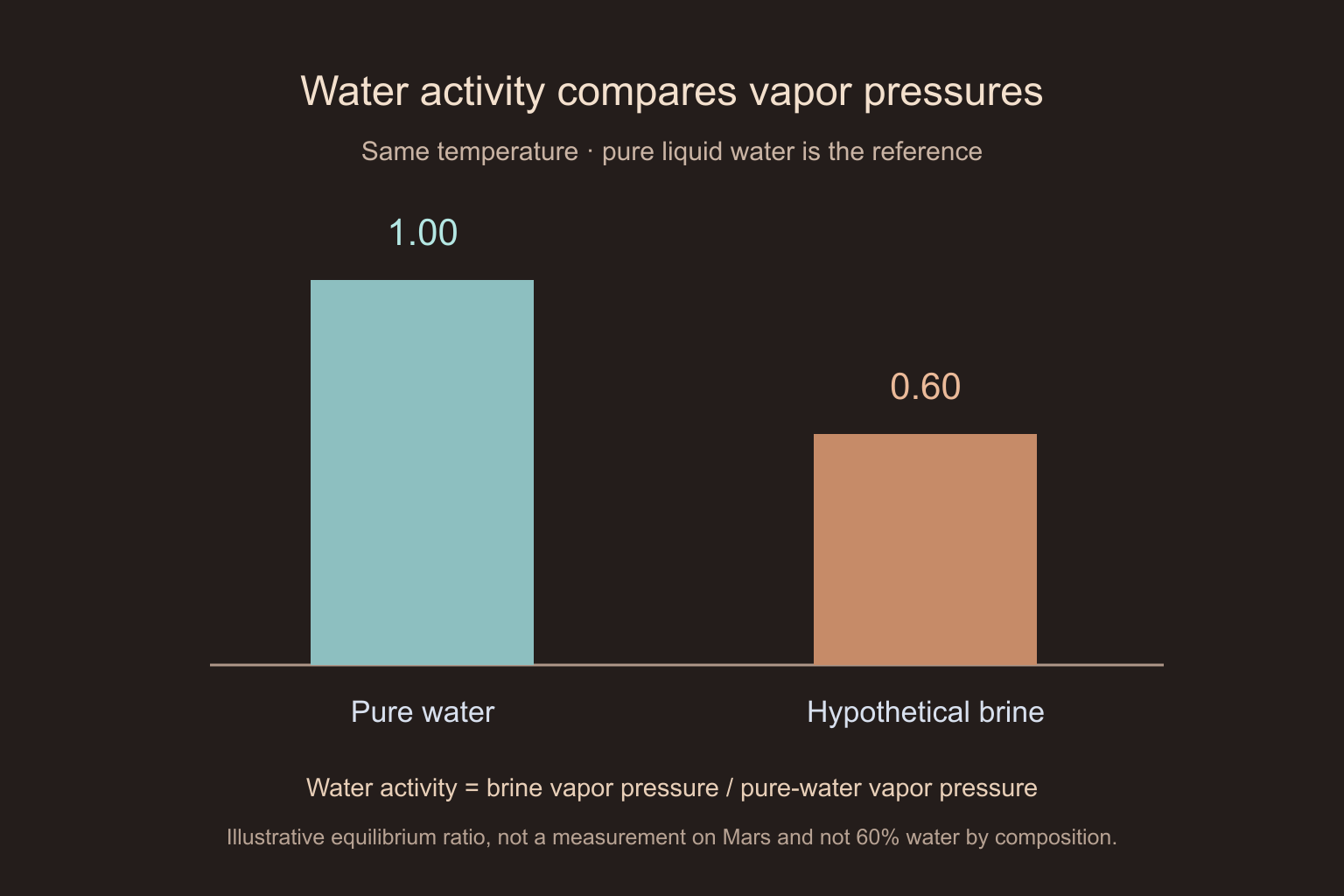
Water activity, written a_w, describes water's thermodynamic availability in a solution. One way to express it is the equilibrium vapor pressure of water above the solution divided by the vapor pressure above pure liquid water at the same temperature.
For a simplified example, if those vapor pressures were in the ratio 0.60, the water activity would be 0.60. That does not mean the liquid is 60% water by mass or volume. It also does not mean that 60% of its water molecules are usable by a cell.
The quantity is a ratio of vapor pressures. Its biological relevance comes from how the solution interacts with cellular chemistry and water balance. Temperature, salt identity, and other conditions still matter; a_w is not a complete habitability score.
Rivera-Valentín and colleagues use this definition in their 2020 study of present-day Martian brines. It helps explain why “liquid” and “suitable for terrestrial life” can point to different conclusions.
What the 2020 model actually found
The researchers combined a thermodynamic framework with Martian climate modeling to examine brines on the surface and in the shallow subsurface, a few centimeters deep. They considered the conditions under which such liquids could form and persist, including temporarily metastable states.
Their modeled brines could exist in a wider range of places and times than previously expected, but at temperatures below 225 kelvins, about −48°C. The combinations of temperature and water activity fell outside known terrestrial-life tolerances used in that analysis.
The Lunar and Planetary Institute's account explains the result as a constraint on habitability under the modeled conditions. It was not a rover's observation of a new puddle, a detection of organisms, or a test of every environment beneath Mars.
The temperature conversion is straightforward: 225 − 273.15 = −48.15°C. The rounded number helps communicate the model's conditions; it is not a universal temperature below which every organism instantly dies.
Survival, growth, and reproduction are different tests
A microbe remaining viable through an extreme interval is different from actively growing there. Surviving a laboratory exposure to one stress also does not show that it can reproduce under a combination of low temperature, limited water activity, and unfavorable chemistry.
Our extremophile guide introduces those combined constraints. For a Martian brine, useful evidence would characterize the same liquid's temperature, composition, water activity, and duration together. Combining the most favorable value from several incompatible conditions would invent a habitat that the evidence does not describe.
What this leaves open
The near-surface model does not settle the habitability of ancient Mars, deeper environments with different conditions, or hypothetical biology with requirements unlike known terrestrial life. Those are distinct questions that need their own evidence.
Nor would demonstrating favorable conditions establish that organisms are present. As our biosignature false-positive guide explains in another setting, a promising environment and a biological detection require different arguments.
When a Mars report mentions liquid water, ask whether the evidence concerns a direct measurement, an interpretation of a feature, a laboratory experiment, or a model. Then ask whether it establishes conditions compatible with life at the same place and time. That sequence keeps an interesting liquid-water result from becoming an unsupported claim of habitability.