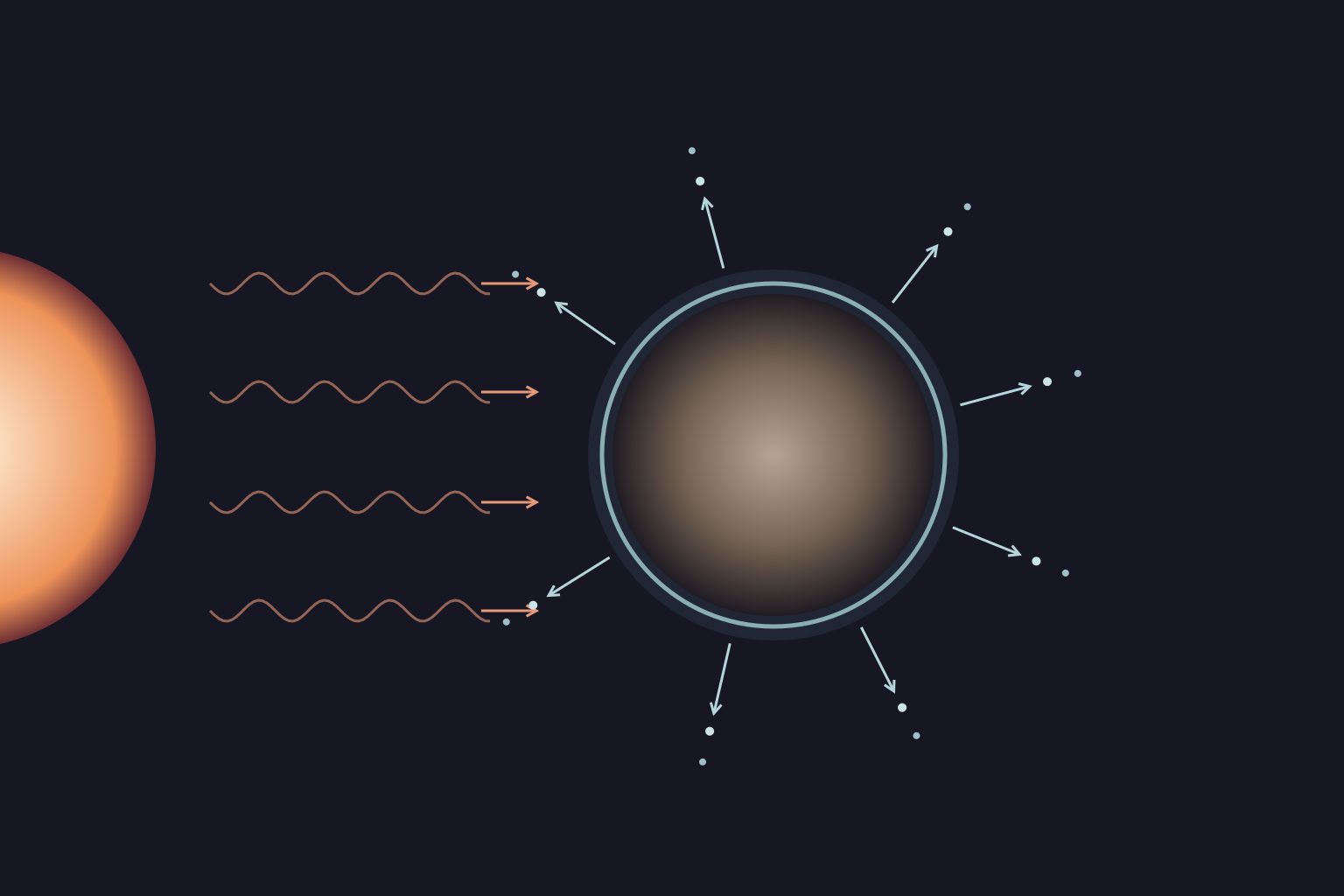
Oxygen on an exoplanet would be an important clue, but it would not establish that life exists there. Some nonliving processes can produce atmospheric oxygen. Interpreting a detection requires evidence about the star, the planet’s water history, and the other gases present.
The question is not whether oxygen can be biological—it clearly can—but whether biology explains a particular planet’s oxygen better than the available alternatives.
Why oxygen is promising
On Earth, oxygen-producing photosynthesis has profoundly changed the atmosphere. That makes molecular oxygen, O₂, a plausible biosignature: an observable feature that could indicate life.
Yet an atmosphere records both production and removal. Oxygen can react with surface materials or other gases instead of accumulating. A world could therefore host life while showing little atmospheric oxygen. In their review of oxygen as a biosignature, Victoria Meadows and colleagues use Earth’s history to explain why both false positives and false negatives matter.
This distinction extends the question discussed in our guide to ocean worlds and biosignatures: identifying a potentially habitable setting and identifying life are separate tasks.
One false-positive route: losing water
Water contains hydrogen and oxygen. If enough water reaches a planet’s upper atmosphere, stellar ultraviolet radiation can split the molecules. Hydrogen can escape to space more readily, potentially leaving oxygen behind.
In a modeling study by Rodrigo Luger and Rory Barnes, young low-mass stars could expose planets to prolonged conditions that drive major water loss. Oxygen could accumulate if the planet does not remove it efficiently through surface reactions or other sinks.
That is a conditional result from planetary-evolution models. It does not mean every planet around a red dwarf loses its oceans, or that an oxygen-rich planet must be dry. Initial water supply, stellar radiation, atmospheric escape, and surface chemistry all affect the outcome.
Another route: splitting carbon dioxide
Ultraviolet light can also break apart carbon dioxide. Under suitable atmospheric conditions, the resulting chemistry can build oxygen without organisms.
Edward Schwieterman and colleagues modeled possible warning signs of this scenario. Carbon monoxide together with carbon dioxide could help identify an atmosphere in which CO₂ photochemistry is an important source of oxygen. They also examined absorption produced when oxygen molecules interact in pairs, which can help distinguish extremely oxygen-rich atmospheres left by water loss.
These are proposed ways to discriminate between explanations. They are not a claim that a telescope has already applied a universal “life test,” and one extra gas is not an automatic verdict either.
The same oxygen clue can lead to different follow-up questions
Consider two hypothetical atmospheres, not two reported discoveries. In the first, oxygen appears alongside evidence compatible with extensive water loss. Researchers would test whether that history can supply the oxygen without biology. In the second, oxygen occurs with carbon monoxide and carbon dioxide. The priority would include testing whether the star’s radiation and atmospheric chemistry can explain that combination.
These cases lead to different observations and models, even though both start with oxygen. The proposed diagnostics in Schwieterman and colleagues’ study help frame those tests; they do not convert either imagined spectrum into a verdict. Missing water features, for example, must not be silently treated as proof that an ocean never existed. An observation’s sensitivity is part of its interpretation.
How to assess an oxygen headline
Start with what was measured. Is there a robust atmospheric detection, a tentative spectral feature, or only a prediction of what an instrument might detect? Those are different results.
Next, look for the environmental context. Does the study constrain the host star’s radiation, the abundance of water and carbon-bearing gases, and plausible nonbiological oxygen sources? Which measurements would distinguish the competing explanations?
Finally, check the wording of the conclusion. “Consistent with life” leaves alternatives open. “Nonbiological oxygen is possible” does not show that the planet is lifeless. A persuasive interpretation needs multiple observations that fit together, with uncertainties and alternative models made explicit.
Oxygen can be valuable evidence. Its scientific value comes from how it fits the planet’s wider chemistry and history, not from treating one molecule as a yes-or-no answer.