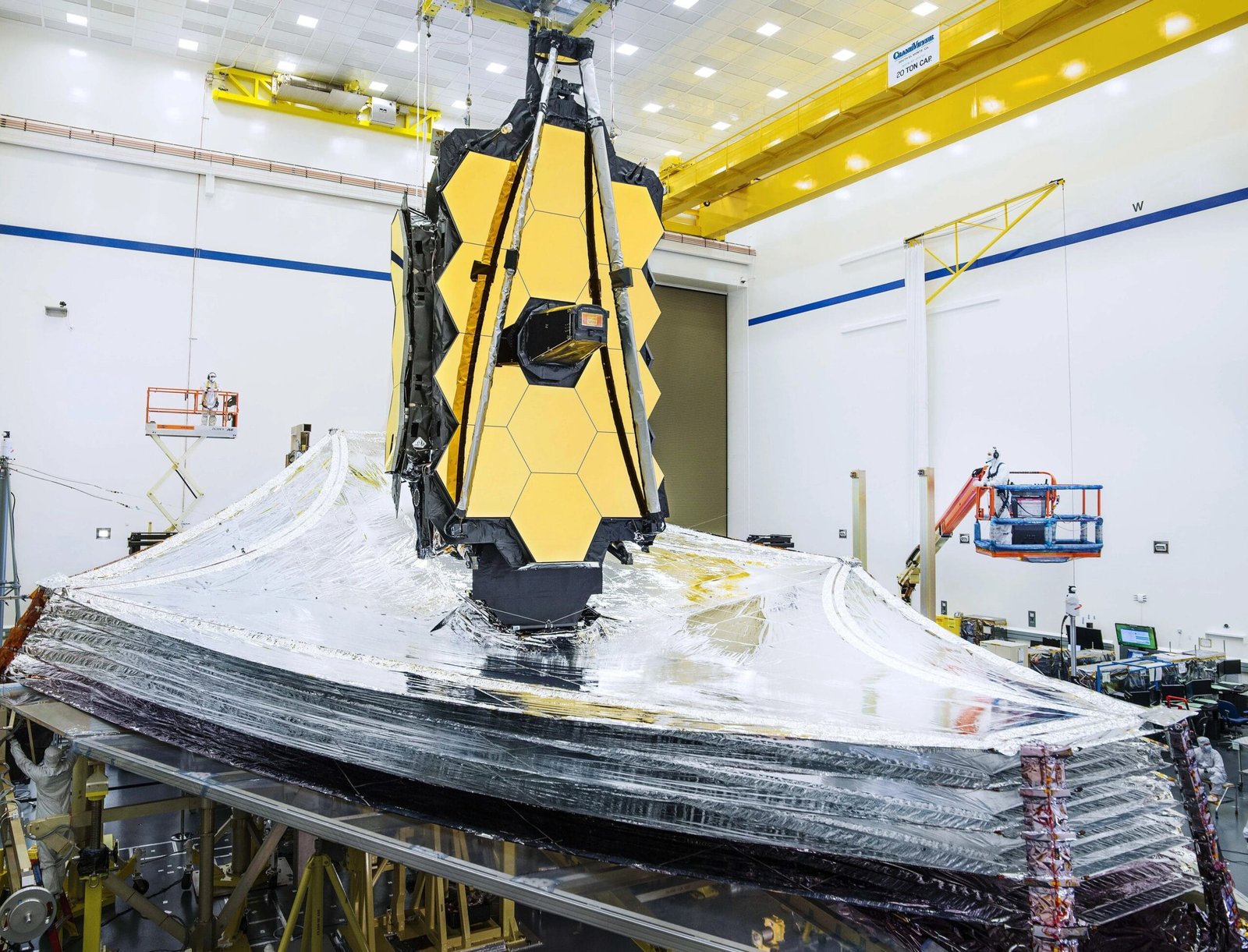
Infrared space telescopes need to stay cold because their own mirrors and instruments emit infrared radiation. That unwanted glow can overwhelm the faint light they are trying to measure. Cooling also helps infrared detectors operate with less internally generated noise. NASA’s Webb cryocooler documentation describes both requirements.
Being in space does not automatically solve the problem. A telescope still absorbs energy from its surroundings and produces heat through its electronics. Its temperature depends on how effectively its design limits incoming heat and lets energy escape.
Why cold space is not enough
The Webb mission team describes cooling as an energy balance: the observatory loses heat by radiating it into space, while sunlight and operating equipment supply heat. The temperature settles when those flows balance. Putting an instrument in orbit does not remove the need to manage them.
Think of the problem as trying to detect a faint signal while the measuring equipment contributes a signal of its own. A warm mirror is part of the infrared scene the detector must deal with. The mission team’s explanation of Webb’s cooldown identifies the mirror’s emission as a reason infrared observatories require such careful thermal design.
There are two connected tasks: reduce the radiation reaching the cold components, and provide a way for their heat to leave.
What Webb’s sunshield actually does
Webb’s five-layer sunshield separates its sensitive telescope from the Sun-facing side of the spacecraft. Its orientation also keeps Earth and the Moon behind the shield.
The layers are separated by gaps. Rather than allowing heat to pass directly through one thick slab, the design lets it escape outward between the layers. The spacing and shape matter as much as the fact that the material casts a shadow. NASA explains these choices in its sunshield engineering guide.
The shield works with the telescope’s open structure. Heat can radiate away into space instead of being trapped inside an enclosing tube. This is passive cooling: the structure and its surroundings do much of the work, without a powered refrigerator cooling every component. NASA’s guide to how Webb stays cold explains why this requirement shapes the observatory’s appearance.
Why MIRI needs its own refrigerator
Webb’s instruments do not all need the same temperature. Its near-infrared detectors can operate at temperatures reached through passive cooling. The Mid-Infrared Instrument, or MIRI, observes longer wavelengths and uses a different detector material that requires temperatures below 7 kelvins, about minus 447 degrees Fahrenheit.
For MIRI, the sunshield alone is insufficient. A powered cryocooler circulates helium and removes heat from the instrument. This is active cooling, added to the protection already provided by the observatory’s design. The cryocooler specifications explain why detector material and wavelength range affect the temperature requirement.
Does Webb eventually run out of coolant?
MIRI’s helium circulates in a closed system. It is reused rather than intentionally boiled away and vented into space. That differs from infrared missions whose observing lifetimes depended on a finite supply of expendable coolant. A closed circuit still depends on functioning machinery and electronics; recycled helium does not guarantee an unlimited operating life. The Webb mission team’s cooling account describes that distinction.
For a broader view of how mirrors, detectors, and spacecraft work together, our guide to space observation technology connects thermal control with the other demands of collecting astronomical light.