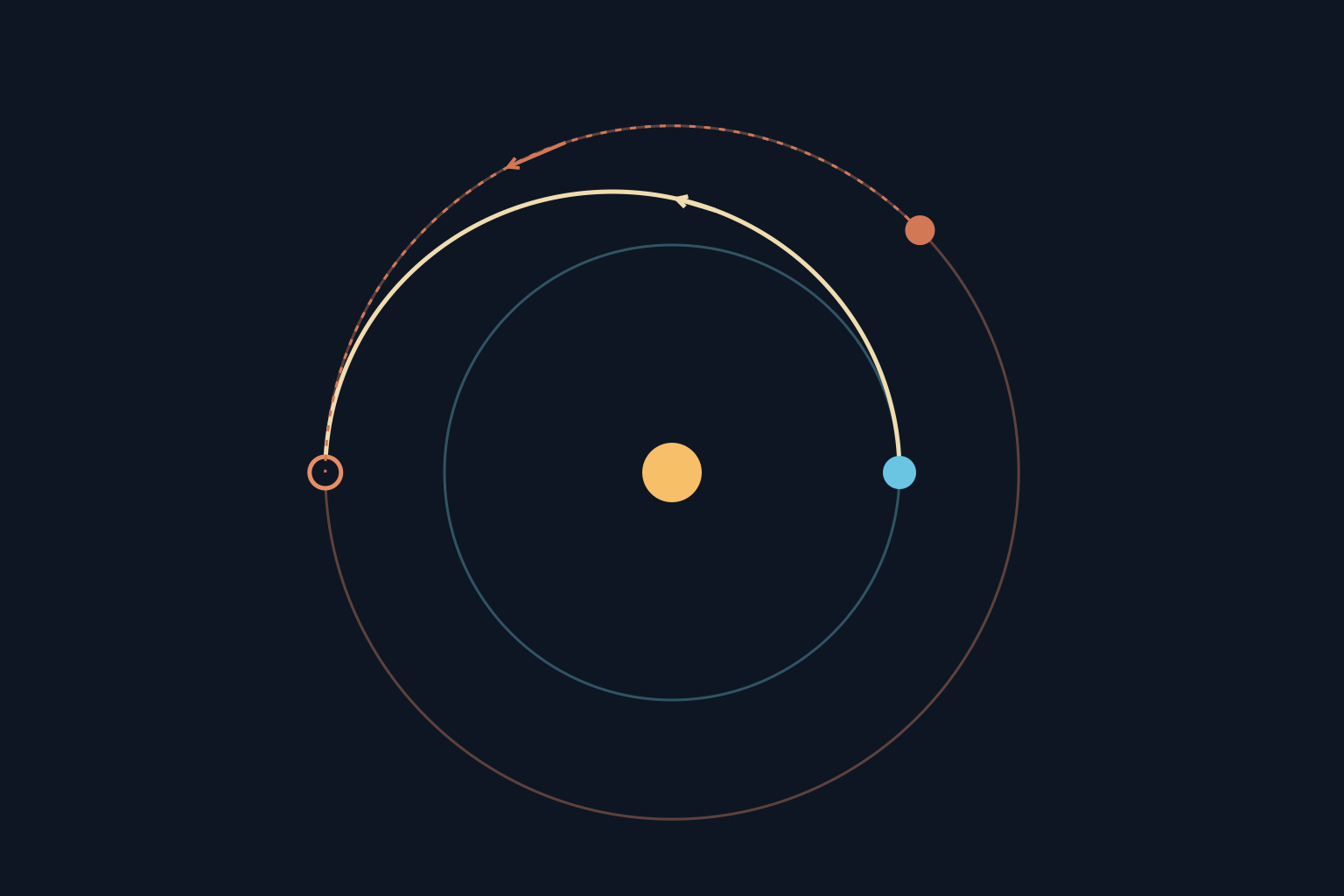
Mars launch windows recur roughly every 26 months because Earth and Mars orbit the Sun at different rates. Efficient routes need a suitable arrangement of the two planets, and that geometry repeats when the faster-moving Earth gains a full lap on Mars.
The window is not simply the day the planets are closest. A spacecraft must intercept Mars where it will be after months of travel, not aim at the planet’s position on launch day.
Where the 26-month interval comes from
Earth takes about 365.25 days to orbit the Sun; Mars takes about 687 days. Their average orbital rates are therefore about 0.986 and 0.524 degrees per day. Earth gains approximately 0.462 degrees per day on Mars.
To gain a complete 360 degrees takes:
360 ÷ 0.462 ≈ 780 days, or about 26 months.
Equivalently, the synodic period is 1 ÷ (1/365.25 − 1/687). This calculation uses rounded mean periods. It explains the recurring opportunity, not the precise opening time for a particular launch. NASA’s planetary parameters provide the orbital-period basis.
Actual windows depend on the planets’ elliptical orbits, the launch vehicle, and the desired arrival conditions. “Every 26 months” is a useful pattern, not a universal timetable with identical opportunities.
Why a spacecraft aims ahead
A simple model is a Hohmann transfer: an elliptical solar orbit that touches Earth’s orbital distance at one end and Mars’ at the other. The spacecraft travels along half of that ellipse while Mars continues moving.
Using circular, coplanar planetary orbits with radii of 1 AU and 1.524 AU, the transfer ellipse has a semimajor axis of 1.262 AU. Kepler’s law gives a half-orbit travel time of about 259 days, or 8.5 months. Mars would move about 136 degrees during that interval, so it must start roughly 44 degrees ahead of Earth, measured around the Sun.
Those are illustrative values, not a flight plan. NASA’s trajectory guide explains the interception geometry; real missions use routes chosen for their own propulsion, arrival, and operational needs.
A launch period is different from a daily window
A mission can have a launch period spanning multiple dates, with a shorter permissible window on each date. Missing a few minutes need not mean waiting another 26 months; missing the entire suitable departure opportunity can be much more consequential.
NASA’s Mars Reconnaissance Orbiter launch press kit provides a historical example of that distinction. Its dates describe that mission, not a reusable schedule for future spacecraft.
Does every Mars mission have to follow this pattern?
No. Extra propulsion, different transfer durations, or an intermediate orbit can change the options. NASA’s March 2026 explanation of ESCAPADE’s route describes spacecraft launched into a loitering trajectory before a later Earth encounter sends them toward Mars. The launch from the ground and the departure onto a Mars-bound transfer need not be the same event.
Our guide to gravity assists explains how a planetary encounter changes a spacecraft’s route. Arrival is another separate constraint: orbital insertion explains why reaching Mars does not automatically mean staying there.
The useful question is therefore not just “When is Mars close?” It is “Which departure and arrival geometry can this mission actually afford?”