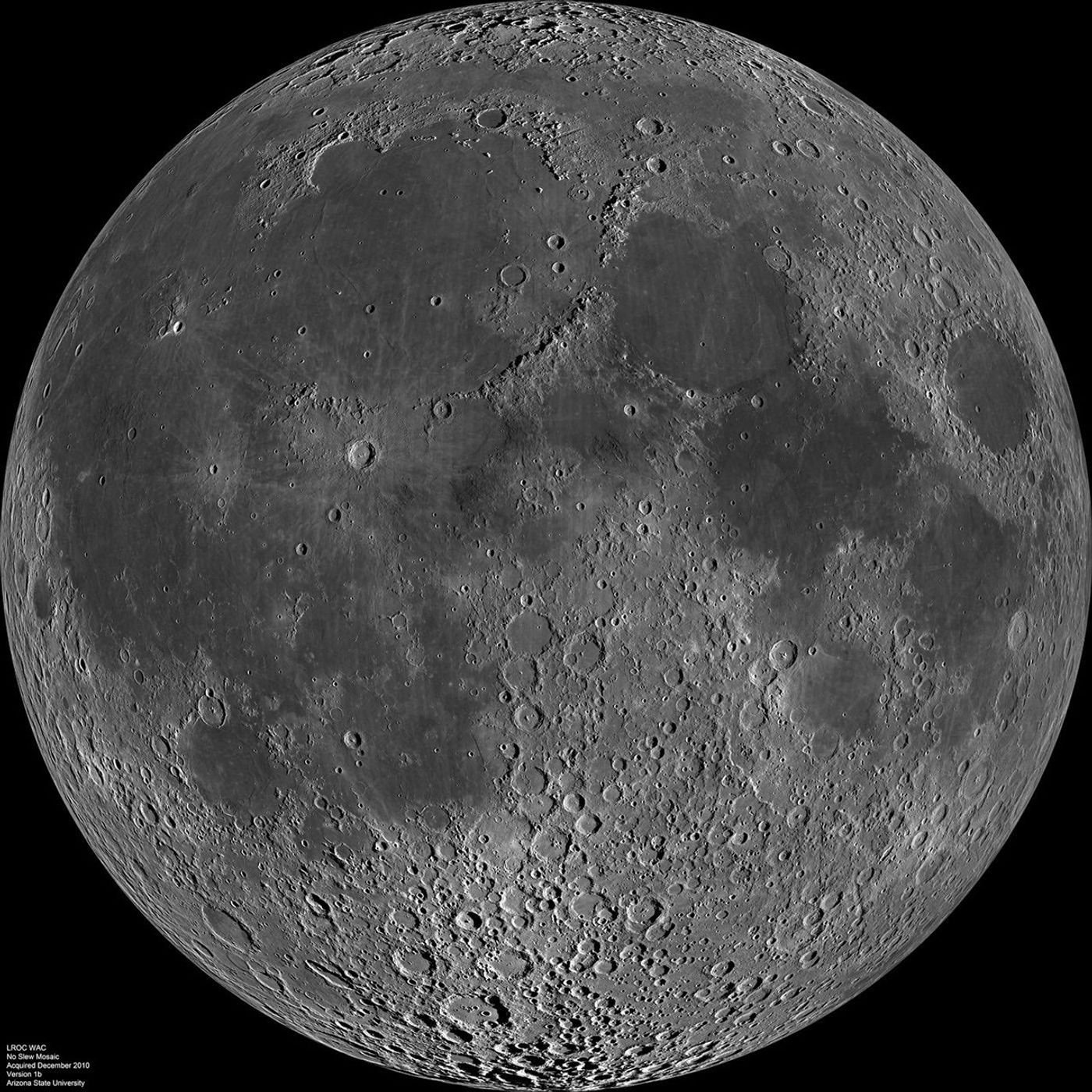
The Moon can look upside down to an observer in another part of the world because “up” depends on the observer's local horizon. People at different locations view the same Moon while standing at different orientations on a curved Earth. The lunar disk therefore appears rotated relative to the directions they call up and down.
This does not mean the Moon suddenly flips over at the equator, that the Southern Hemisphere sees its far side, or that one hemisphere gets a different lunar phase.
The same lunar face, a different local up
NASA's Moon questions and answers distinguishes the Moon's phase from its orientation. Observers who can see the Moon at the same time see essentially the same illuminated fraction, but the bright portion can point in different directions relative to their horizons.
Picture two photographs of the same printed disk, taken with the camera rotated between shots. The disk's features remain in the same arrangement, but the top of the photograph changes. Changing your location on Earth similarly changes the reference directions against which you view the Moon.
That camera comparison illustrates orientation only. It does not model every aspect of lunar viewing geometry, including the small changes in perspective between widely separated observers.
Is the Southern Hemisphere view always exactly 180 degrees different?
No. The familiar upside-down comparison is useful, but it is not an exact rule for every pair of cities at every observing time.
In The Planetary Society's explanation, Kate Howells describes how the apparent orientation varies with the observer's location and with the Moon's movement across the sky. The change is continuous with latitude. Crossing the equator does not produce an abrupt visual switch.
Your local horizon also changes its angle relative to the lunar disk as Earth rotates. Consequently, the Moon can appear tilted differently at rising, high in the sky, and setting even from one location. Comparing two photographs requires their observing times and image orientations, not just their countries.
This is why a crescent's tilt alone is an unreliable shortcut for assigning a photograph to a particular hemisphere.
Rotation is not a mirror reversal
Turn a page upside down and printed letters rotate with it. Look at the page in a mirror and their handedness reverses. Those are different transformations.
The geographical orientation effect rotates the apparent lunar disk relative to your horizon; it does not create a mirror image of its surface. If two pictures will not line up after rotation, check how they were captured and processed. A telescope's optical arrangement or a flipped image can introduce an additional reversal that geography alone does not explain.
Try a simple comparison indoors: draw an uneven pattern on a circle, label one feature, and rotate the paper. The labeled feature changes position on the page but retains its neighbors. The exercise demonstrates the difference between changing a frame of reference and changing the object itself.
Phase, rotation, and libration are separate effects
Phase describes how much of the Moon's sunlit half is visible from Earth. NASA's Moon phase guide explains that this changes as the Moon moves around Earth. Ordinary phases are not caused by Earth's shadow; that shadow is relevant to a lunar eclipse.
The Moon also rotates, keeping broadly the same hemisphere facing Earth as it orbits. Small apparent nodding and rocking motions, called libration, let us see somewhat around its edges over time. Libration is a real change in which edge regions are visible. It is different from rotating the same face within the frame of a photograph.
Separating rotation, orbital motion, and a changing viewpoint is useful elsewhere too; our explanation of the different day lengths on Venus shows why those motions should not be treated as interchangeable clocks.
How to compare two Moon pictures fairly
Start with pictures from approximately the same time, since the phase changes during the month. Check whether each image keeps the observer's horizon level or has been rotated into a standard map orientation. Then match several recognizable surface features, not just the crescent's tip.
If the features agree after rotation, the apparent difference can be explained by orientation. If the illuminated fraction differs substantially, timing is another factor. If the pattern is reversed, investigate the optical setup or image processing. These checks answer different questions that “upside down” often bundles together.