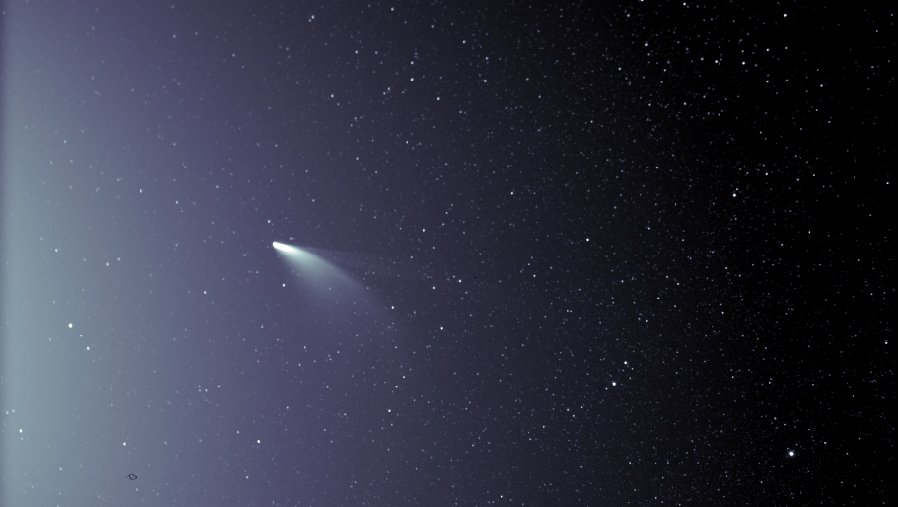
Comet tails are shaped mainly by sunlight and the solar wind, so they generally extend away from the Sun rather than simply trailing behind the comet’s motion. The two main tails respond differently: dust is pushed by radiation pressure, while ionized gas interacts with the solar wind and its magnetic field.
That is why a comet can have a curved dust tail and a straighter ion tail pointing in different directions. Neither is a reliable arrow showing where the comet has just been.
First, the comet has to release material
A comet’s solid nucleus contains ice mixed with dust and rocky material. Solar heating can turn ice directly into gas—a process called sublimation—and escaping gas carries dust outward. The surrounding cloud is called the coma.
The coma and tails can be vastly larger than the nucleus. A dramatic tail therefore does not mean the solid object is equally enormous. NASA’s comet overview distinguishes these parts and the way activity develops as comets approach the Sun.
The material is not smoke from combustion. Sunlight heats the nucleus and illuminates or excites the material it releases; no fire is required.
Dust and ions take different paths
Dust grains scatter sunlight, making a broad tail visible. Photons also transfer momentum to the grains, producing radiation pressure. The grains retain orbital motion as they are released, and their sizes affect how strongly radiation pressure changes their paths. Together, those effects can produce a curved fan.
For a related example of sunlight scattered by small particles in space, see how zodiacal light forms. The diffuse interplanetary dust cloud is a different structure from an individual comet’s active tail.
The ion tail contains electrically charged gas. Its interaction with the solar wind and the magnetic field carried by that wind usually makes it narrower and more nearly aligned with the direction away from the Sun. ESA’s explanation of Comet ZTF’s tails describes the different forces acting on dust and ions.
Can a tail point ahead of the comet?
Yes. After a comet rounds the Sun and travels outward, its approximately anti-solar ion tail can extend ahead of its direction of travel. The comet has changed its orbital direction; the Sun still determines the broad direction in which the released ions are carried.
Picture a comet moving away from the Sun on the right side of a diagram. Its ion tail can also stretch to the right. A drawing that always places the tail behind the moving nucleus would miss this geometry. Dust adds complexity because its tail is curved and contains particles released at different times.
What about a tail that appears to point toward the Sun?
An anti-tail can arise from viewing geometry. Dust distributed near a comet’s orbital plane may project into a narrow feature that appears to point sunward from Earth. It does not require a new force blowing the main ion tail back toward the Sun.
ESA’s Rosetta overview discusses this apparent extra tail. The practical lesson for reading a comet photograph is to distinguish the comet’s orbit, the direction of sunlight, and our viewing angle. A two-dimensional image compresses all three into a single view.