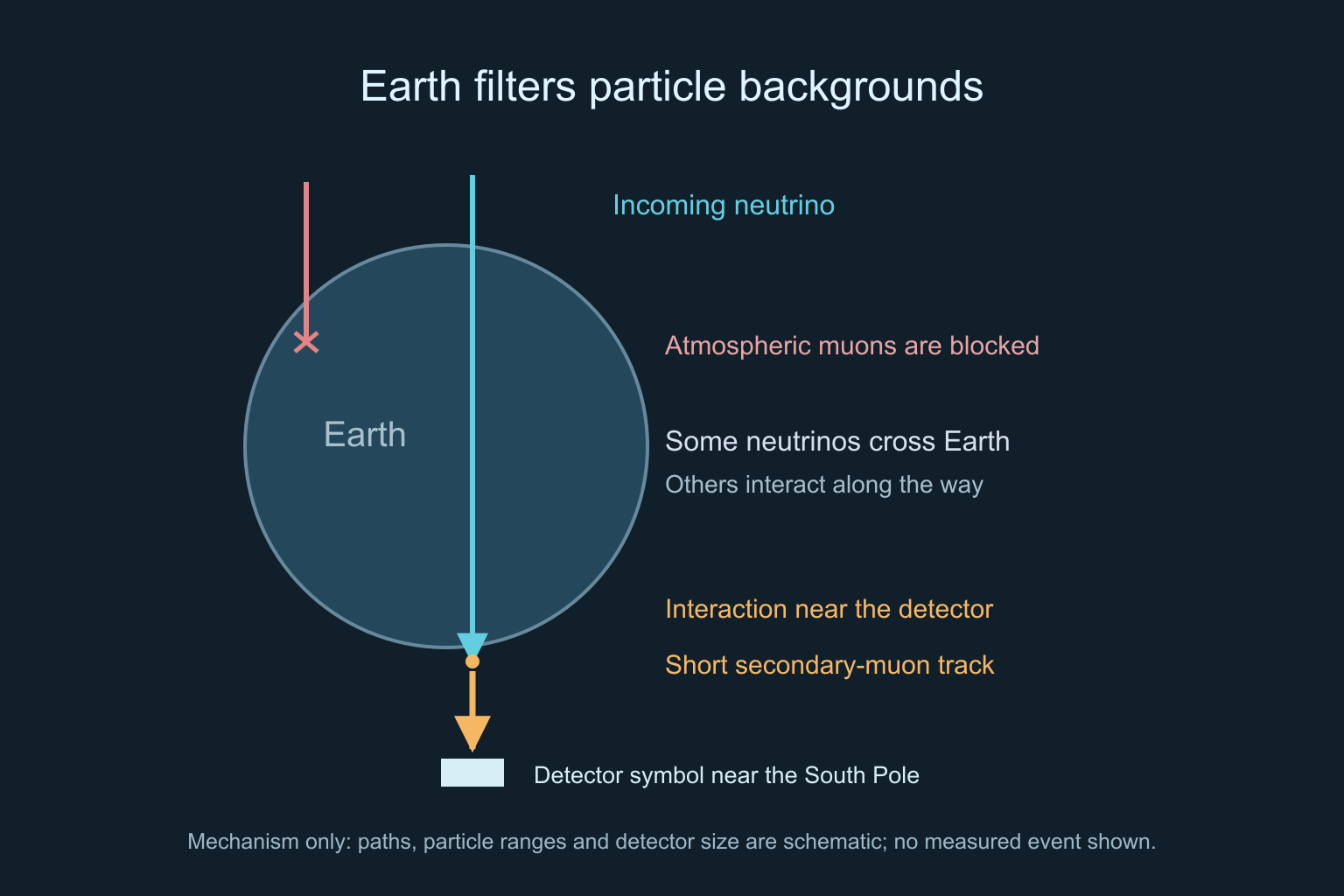
IceCube can use Earth as a filter: rock stops the atmospheric muons that would otherwise overwhelm some neutrino searches, while many neutrinos pass through the planet. At the South Pole, a particle track traveling upward through the detector can therefore provide evidence of a neutrino arriving from the northern sky.
This does not mean Earth blocks every background or is transparent to neutrinos at every energy. The detector's selection method, the particle's energy, and its path through the planet all affect what can be inferred.
What the sensors actually detect
IceCube's optical sensors do not photograph a neutrino directly. A neutrino sometimes interacts with matter in or near the instrumented ice, producing secondary particles. A fast charged particle can emit Cherenkov light when it travels faster than light travels in ice.
It still travels slower than light's speed in a vacuum. The distinction is different from the cosmological recession discussed in our faster-than-light galaxy explainer: here the comparison concerns a particle moving locally through a material.
The IceCube collaboration's detector description explains how light recorded across the array carries information about the interaction. Arrival times and the distribution of light help reconstruct direction and energy. For a muon track, this reconstruction supplies the direction used in an upward-going event selection; it is not a photograph of the incoming neutrino.
Why an upward track is useful
Cosmic rays striking Earth's atmosphere create showers of secondary particles, including muons. Many downward-moving muons can penetrate the ice above IceCube. Without background rejection, their tracks would greatly outnumber the events sought in high-energy neutrino astronomy.
A muon produced in the atmosphere on the far side of Earth cannot simply cross the entire planet to reach the detector. A neutrino can make that journey and then interact close enough to produce a detectable muon. The direction of the resulting track is therefore a powerful selection clue.
Lawrence Berkeley National Laboratory's IceCube description illustrates this upward-looking geometry. Because the detector sits at the South Pole, upward-going tracks correspond broadly to directions in the northern celestial hemisphere. This is a statement about reconstructed arrival directions, not a claim that the telescope physically rotates underground.
Why upward does not automatically mean cosmic
Atmospheric particle showers produce neutrinos as well as muons. Those neutrinos can also pass through Earth and interact near IceCube. The planet removes an important muon background, but it does not label the surviving neutrinos with their origins.
A high-quality upward track consequently supports a neutrino interpretation without, by itself, identifying a distant galaxy, black hole, or stellar explosion as its source. Researchers also examine energy, direction, timing, and the expected backgrounds. A reconstructed track is an observation; an astrophysical-source association is a further inference.
That qualification sharpens the distinction introduced in our overview of neutrinos in astronomy. Rare interaction makes neutrinos useful messengers and makes collecting an interpretable sample difficult.
Earth also absorbs some high-energy neutrinos
Neutrinos are weakly interacting, not incapable of interacting. At sufficiently high energies, traversing more Earth can noticeably reduce the number that survive to reach the detector. The attenuation depends on energy and the amount of matter along the path.
The IceCube collaboration's 2017 measurement of neutrino absorption in Earth used this effect to investigate neutrino interactions. Comparing different paths was part of the measurement, rather than an inconvenience that could be ignored.
This creates a trade-off: looking through Earth suppresses atmospheric muons, but the same material also reduces some of the high-energy neutrino signal. There is no single direction that is best for every analysis.
Can IceCube use the southern sky too?
Yes. It can use other selection methods instead of requiring a track to come through the planet. One approach looks for interactions that begin inside the detector and rejects particles seen entering from outside.
A 2019 IceCube study of starting tracks describes an event-specific veto for southern-sky searches. It also explains how atmospheric neutrinos accompanied by detectable muons can be rejected. That is a different filtering strategy, not an extension of Earth's shielding to downward-going tracks.
When reading an IceCube result, identify the event type, the accepted directions, and the background-rejection method. “A neutrino detector at the South Pole” describes the instrument; those additional details explain how a particular discovery was tested.