The Roche limit describes how close a satellite held together mainly by its own gravity can orbit a larger body before tidal forces prevent it from remaining intact. It is a model-dependent distance, not an invisible wall that destroys every moon, spacecraft, or ring particle crossing it.
The satellite's density, internal strength, spin, and orbital conditions matter. A commonly quoted formula treats it as a deformable fluid with no material strength. Applying that result to a solid rock without checking the assumptions changes the question being answered.
The problem is the difference in gravity across the moon
A planet pulls more strongly on the near side of a moon than on the far side. Relative to the moon's center, this uneven pull stretches the body along the planet–moon direction. The moon's self-gravity resists that deformation.
Moving closer to the planet strengthens the differential pull. The relevant comparison is therefore tidal stress against the forces holding the satellite together, rather than simply the planet's total gravitational attraction against the moon's weight. Our guide to planets and moons introduces the broader effects of tides; disruption is one limiting case.
That distinction also explains why a ring can contain intact particles. A small solid fragment has material strength; it is not merely a miniature fluid moon held together by self-gravity.
What the familiar formula assumes
For a small fluid satellite in a circular, synchronously rotating configuration around a much larger, approximately spherical primary, the classical estimate is:
Roche distance ≈ 2.44 × primary radius × (primary density ÷ satellite density) to the one-third power.
The densities are mean densities in matching units. The distance runs from the primary's center, not its surface. INAF's satellite and ring notes present this estimate and the physical restrictions behind its coefficient.
The formula makes the density dependence explicit: a denser satellite has stronger self-gravity for its size and can approach more closely within this idealized model. It does not supply the exact failure point of a particular fractured, rotating moon.
A worked example: distance is not altitude
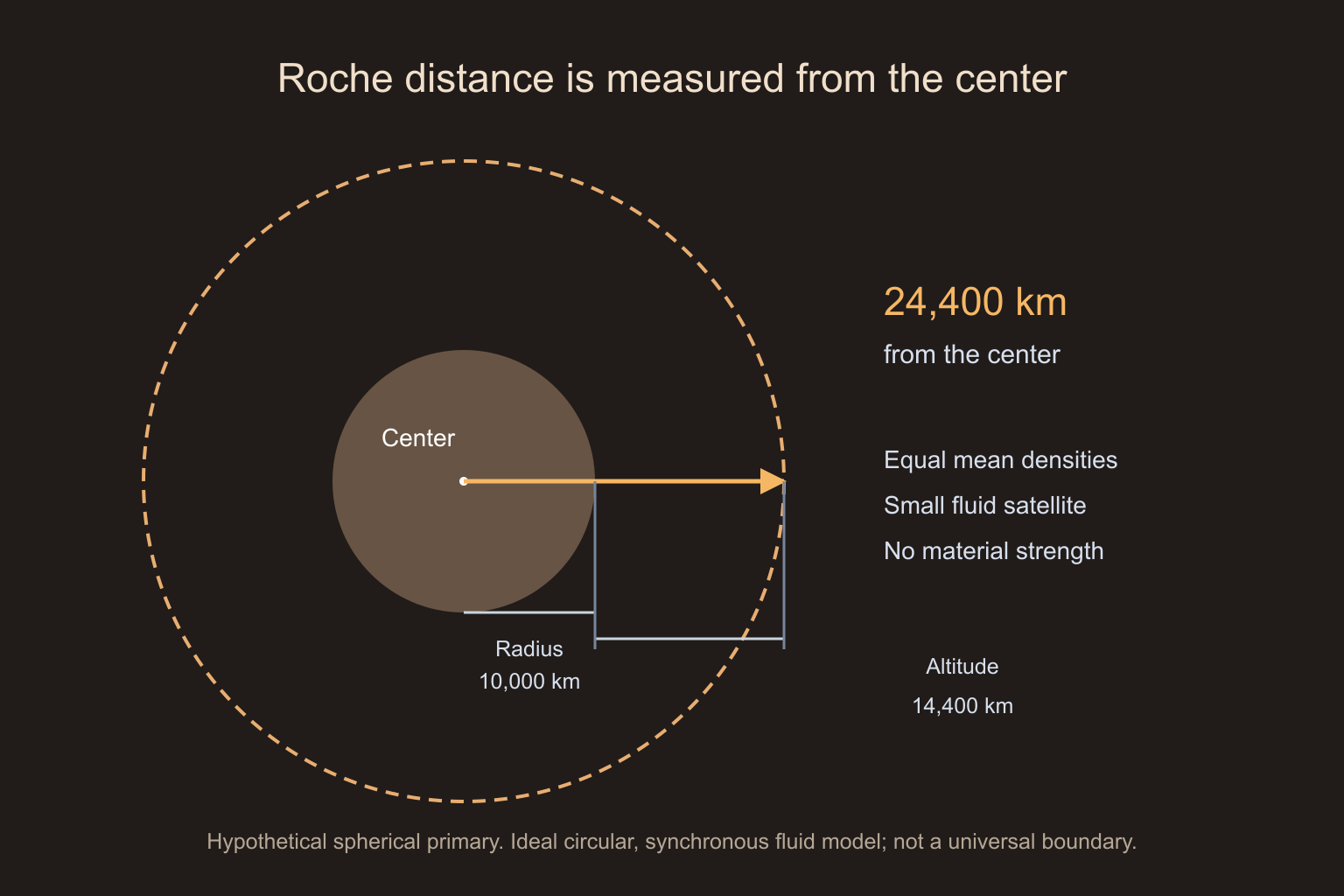
Imagine a spherical planet with a radius of 10,000 kilometers. Give its hypothetical fluid satellite the same mean density as the planet. The density ratio is one, so the estimated Roche distance is 24,400 kilometers from the planet's center.
The corresponding height above the surface is 14,400 kilometers, after subtracting the planet's radius. Confusing these two distances would put the supposed boundary 10,000 kilometers in the wrong place.
If the hypothetical satellite instead had eight times the planet's mean density, the cube-root factor would be one-half. The same model gives 12,200 kilometers from the center, or 2,200 kilometers above the surface. These deliberately simplified numbers demonstrate scaling; they are not predictions for an actual moon or a safe spacecraft trajectory.
Why solids do not obey one fluid boundary
Rock and ice can resist tension and deformation through material strength. Their behavior also depends on cracks, shape, rotation, and the duration of the encounter. A close passage on an eccentric orbit is not the same physical setup as a settled circular orbit.
Aggarwal and Oberbeck's study of tidal fracture in solid bodies distinguishes fracture modes and the roles of size, strength, and elasticity. Those differences explain why one fluid coefficient cannot describe every solid. An exact survival distance requires a model suited to the particular object.
For a spacecraft, structural integrity and trajectory need their own engineering analysis. Crossing a Roche distance calculated for a fluid moon is not, by itself, a spacecraft failure condition.
Quaoar shows why ring formation needs more than one rule
In 2023, researchers reported a dense ring around Quaoar well outside its classical Roche limit. The discovery paper's abstract describes a ring roughly 7.4 Quaoar radii from the center and identifies unusually elastic collisions as a possible reason particles do not readily combine into a moon.
The research team's institutional explanation separates tidal disruption from the reverse process of particles assembling. Collision behavior and orbital resonances also enter that second problem. A ring outside the classical boundary does not mean gravity has stopped working.
When encountering a Roche-limit claim, check which body's center defines the distance, which densities were used, and whether the calculation assumes a strengthless fluid. Those details determine what the number can actually explain.