Apparent magnitude describes a star's brightness as measured from our location. Absolute magnitude describes how bright it would appear at a standard distance of 10 parsecs, about 32.6 light-years. In both scales, a smaller number means a brighter object, including negative numbers.
The distinction is essential when comparing stars. A nearby, modest star can look brighter than a distant, much more luminous one. Apparent brightness alone does not tell you which emits more light.
Why the numbers run backward
The magnitude scale preserves the historical convention of assigning smaller numbers to brighter stars. Its modern definition is logarithmic: a difference of five magnitudes corresponds to a brightness ratio of exactly 100 in the same measurement band and system.
OpenStax's introduction to stellar brightness explains the convention. A one-magnitude step represents a factor of about 2.512, rather than an equal additive quantity of light.
For example, a magnitude +1 star supplies 100 times the measured flux of a magnitude +6 star in the same band. A magnitude −1 star is brighter than a magnitude +1 star; their two-magnitude gap corresponds to about 6.31 times the flux. The negative sign is not a negative amount of light.
For any magnitude difference, the ratio is 10 raised to the power of 0.4 times that difference, with the brighter object's flux in the numerator. A four-magnitude difference therefore gives 10 to the power 1.6, or about 39.8.
What absolute magnitude standardizes
Las Cumbres Observatory's absolute-magnitude explanation describes the 10-parsec reference. Putting stars at a common hypothetical distance removes distance as the reason one appears brighter than another.
It does not mean that astronomers physically move the stars or that every catalog measurement covers all emitted wavelengths. An absolute magnitude normally refers to a specified photometric band.
A useful reading habit is to ask which distance convention and which wavelength band a quoted number uses. “Magnitude 2” without that context leaves part of the comparison unspecified.
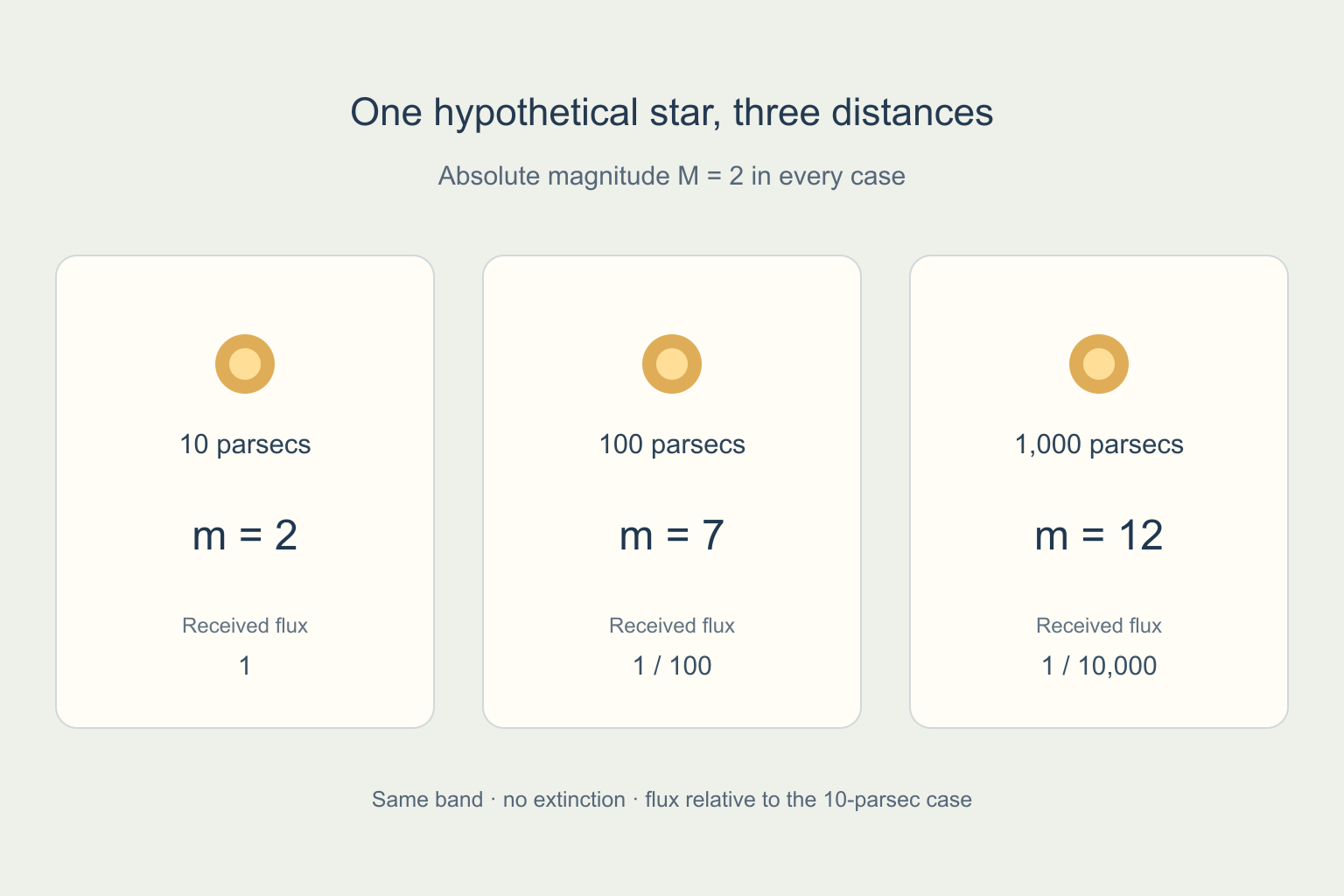
One hypothetical star at three distances
Take a nonvarying star with absolute magnitude M = +2 in a chosen band. Ignore intervening absorption and scattering, and keep the same measurement system throughout.
At 10 parsecs, its apparent magnitude is m = +2. By definition, the actual and reference distances coincide.
At 100 parsecs, its apparent magnitude is m = +7. Moving it ten times farther away reduces the received flux by a factor of 100, adding five magnitudes.
At 1,000 parsecs, its apparent magnitude is m = +12. Another tenfold increase in distance adds another five magnitudes. The star itself has not become less luminous in this example.
These results follow the distance modulus: m − M = 5 log10(d) − 5, where d is the numerical distance in parsecs. This form assumes no extinction. The three cases are a calculation, not measurements of a named star.
Two cautions before comparing catalog numbers
First, compare the same band. A star's blue-band magnitude and its red-band magnitude measure different portions of its spectrum. Las Cumbres Observatory's guide to magnitude and color explains why filters matter. A difference between bands can carry information about color; it is not automatically a disagreement between observations.
Second, account for dust. Extinction can reduce the flux reaching us, making a star's apparent magnitude larger. In that case the observed distance modulus includes an additional extinction term. Treating all of the dimming as distance would give a misleading result.
Real stars can also vary. When following a variable star, compare measurements taken in the same band and consider the observing times. A larger magnitude may indicate genuine fading, obscuration, or a measurement issue; the number alone does not decide the cause.
When a star chart lists apparent magnitude, use it to compare how bright stars appear in the stated band. When a physical comparison uses absolute magnitude, check the common-distance convention, wavelength band, and extinction correction before drawing a conclusion about intrinsic brightness.