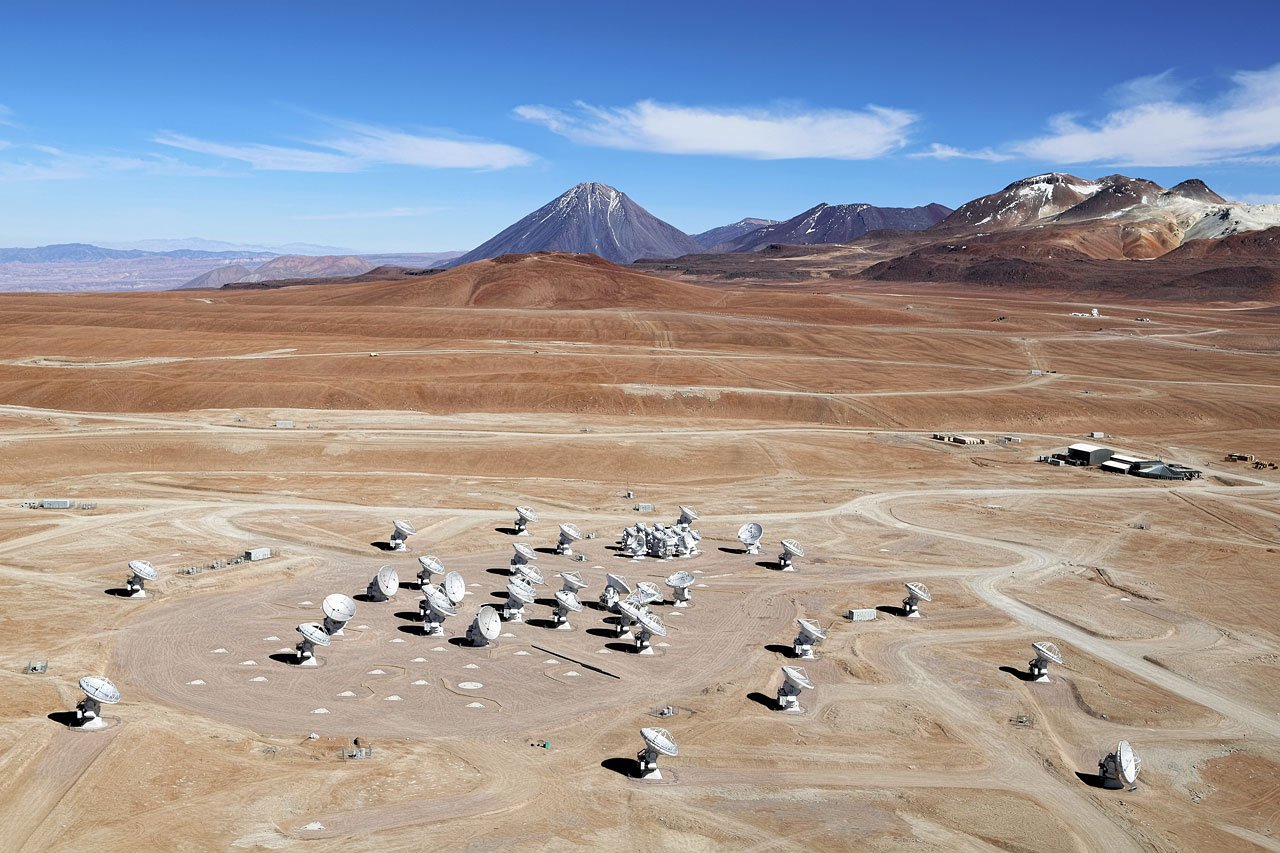
Radio interferometry combines signals from separated antennas to measure fine structure in the sky. Increasing the distance between antennas can improve angular resolution, but it does not fill the space between them with collecting surface. An array can therefore resolve detail on the scale associated with a very large dish without collecting as much radiation as that imaginary dish.
The distinction separates two questions: how close together can features be before they blur together, and how faint a signal can the instrument measure?
Baseline controls the scale of fine detail
The separation between a pair of antennas is its baseline. Combining many pairs samples the radio emission in ways that let astronomers reconstruct an image. Longer projected baselines measure finer angular structure; shorter ones provide information about broader structure.
ALMA's interferometry explanation gives the useful approximation that angular resolution scales as wavelength divided by baseline. At the same observing wavelength, spreading an array farther apart can distinguish smaller angular features.
For a worked example, use a wavelength of 1 millimeter and a baseline of 1 kilometer. Converting both to meters gives 0.001 divided by 1,000, or one millionth of a radian: about 0.21 arcseconds. Increase the baseline to 10 kilometers and the corresponding scale becomes about 0.021 arcseconds.
These are illustrative angular scales, not promised performance for a named observation. The actual synthesized beam depends on projected baselines, observing time, weighting, and other choices. NRAO's VLA resolution documentation makes those dependencies explicit.
Collecting area comes from the antennas
ALMA's main array has fifty 12-meter antennas. Ignoring blockage and efficiency, one circular 12-meter aperture has an area of about 113 square meters. Fifty have about 5,655 square meters of geometric area.
A filled circular aperture with that area would be roughly 85 meters across: 12 multiplied by the square root of 50. Moving those same antennas kilometers apart does not change that sum. This calculation compares physical collecting areas only; it does not claim that the array and an 85-meter telescope have identical sensitivity or observing capabilities.
NRAO's Event Horizon Telescope infographic separates collecting area, which contributes to sensitivity, from antenna separation, which sets the finest resolution scale. Sensitivity also depends on receiver noise, bandwidth, integration time, calibration, and what kind of source is being measured. Baseline length alone cannot answer whether a faint object will be detectable.
Why spreading antennas out can hide extended emission
High resolution is useful when the question concerns compact structure. It is not automatically the right choice for a broad, faint cloud.
An interferometer does not record every spatial scale equally. NRAO's technical guide explains that insufficiently short baselines can leave large-scale emission poorly measured. An image may retain bright knots while missing much of the smooth emission around them. Processing cannot reliably invent the measurements that were never taken.
That is why ALMA combines its main array with compact-array and single-dish measurements. The additional observations provide information about extended emission rather than simply sharpening the smallest features.
Imagine a research question about the total amount of emission across an entire cloud. A striking high-resolution view of three small knots might be an incomplete answer. A second question about the spacing of those knots could need precisely the long-baseline data. The useful configuration follows the measurement, not a universal preference for maximum separation.
Read “a telescope the size of Earth” carefully
For an Earth-spanning radio array, that phrase describes the enormous separation used to obtain fine angular resolution. It does not mean that Earth's surface has become one continuous radio receiver.
When assessing an array image or headline, look for the observing wavelength, baseline coverage, and whether compact-array or single-dish information was included. Those details help explain both the structures that appear and the structures the measurement may miss. Our introduction to radio astronomy explains the signal and calibration steps behind the image; the array's geometry determines which angular scales those signals can constrain.