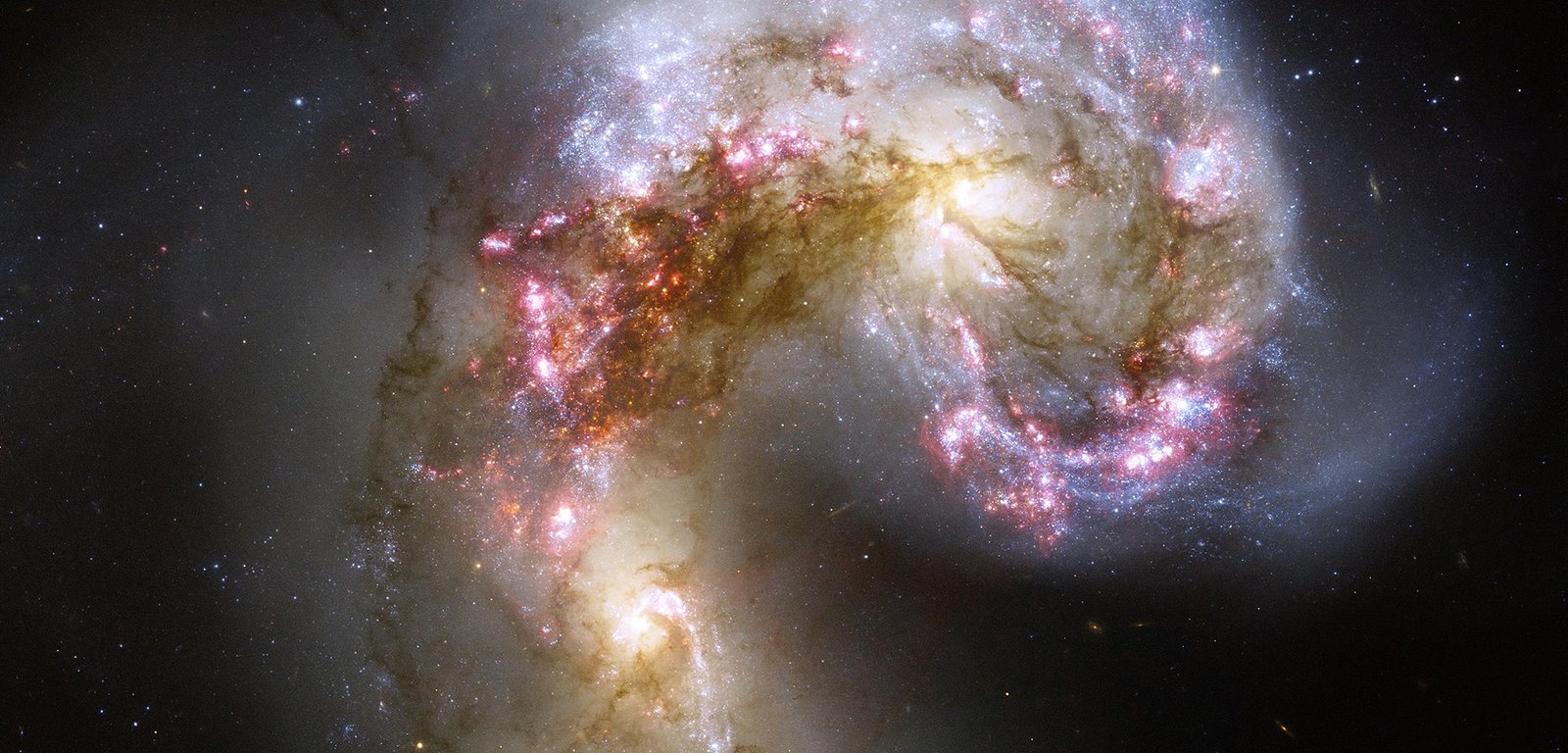
Stars rarely collide directly when galaxies merge because the distances between ordinary stars are enormous compared with their sizes. Galaxies can overlap and strongly alter one another through gravity while most individual stars pass far apart. Their gas behaves differently: interacting gas can be compressed, heated, and rearranged, sometimes fueling new stars.
The word “collision” therefore describes an encounter between vast stellar systems. It does not mean that every bright point in one galaxy strikes a bright point in the other.
Put the empty space on a familiar scale
OpenStax's discussion of galaxy mergers compares the Sun's roughly 1.4-million-kilometer diameter with a nearby-star separation of about 4 light-years, or 38 trillion kilometers. The gap is about 27 million solar diameters.
Shrink a Sun-sized star to a dot 1 millimeter across while preserving that ratio. The other dot would be about 27 kilometers away. Each star is physically large; the separation is vastly larger.
This is a scale model of a solar-neighborhood spacing, not a simulation of an entire galaxy or a numerical probability of collision. Stars are not uniformly distributed. Dense star clusters and galactic centers have different encounter conditions, and stellar encounters require more careful dynamics than drawing dots on a page.
The model answers the immediate puzzle: the luminous appearance of a galaxy in a photograph does not imply that its stars occupy most of its volume.
Gravity can change an orbit without contact
The stars need not touch for an encounter to transform the galaxies. As the mass distributions move past one another, their changing gravitational fields alter stellar trajectories. Stars can be redistributed into extended streams and tidal tails, and the remnant can have a different overall structure.
The Sloan Digital Sky Survey's galaxy-interaction guide emphasizes that even a close passage can distort galaxies. A merger is one possible outcome of a gravitational encounter; two galaxies appearing close on the sky does not by itself establish that they are merging.
Consider two different events: a star's path bends because another system changes the surrounding gravitational field, or two stellar surfaces physically intersect. The first can happen over large distances. The second requires an exceptionally close approach. Conflating them makes galaxy collisions sound like two solid objects smashing together.
Gas is not a collection of widely separated stars
Interstellar gas extends through regions between stars and can interact as material from the galaxies meets. Chandra's explanation of colliding galaxies distinguishes rare star-to-star impacts from interactions between gas and dust clouds.
Compression can help some gas become gravitationally unstable and form stars. Other gas can be heated or displaced. The outcome depends on how much gas is available and on the encounter's geometry and dynamics; “merger” is not a guarantee of a uniform burst of star formation everywhere.
This also changes how an image should be read. Bright knots can represent young stellar populations in affected gas, not flashes from stars crashing together. Long luminous extensions trace redistributed material. The image alone does not provide a complete three-dimensional reconstruction or an inventory of every stellar encounter.
Does a merger destroy the stars or their planets?
Most stars are not physically smashed simply because their parent galaxies interact. That does not establish that every planetary system remains undisturbed. A close stellar encounter can perturb a system, and environments differ greatly across a galaxy. A specific claim about a planet requires its local conditions, not just the label “galaxy merger.”
Likewise, predicting the timing and outcome of a particular future galactic encounter requires measured motions and dynamical modeling. The spacing argument alone cannot supply a collision date.
For interpreting observations, combine the system's shape with measurements of motion, gas, and stellar populations. Even galaxy color has several possible explanations. A distorted outline is evidence to investigate an interaction; it is not a picture of billions of stellar impacts.