Sound needs matter through which to travel, so ordinary sound cannot cross empty space. But space is not empty everywhere, and a clip labeled “sounds of space” may be a microphone recording, a representation of physical pressure waves, or a sonification that maps other measurements into audio. The label alone does not tell you which.
These are legitimate but different ways to present evidence. Knowing how a clip was made changes what you can infer from hearing it.
A microphone can record sound on another world
Mars has an atmosphere, and Perseverance carries microphones. NASA identifies one SuperCam recording as having been made on February 19, 2021, with a small amount of wind audible. The rover’s mast was still stowed, which affected the recording.
That is acoustic data measured locally. A microphone responds to pressure changes in its surroundings; the resulting measurements are then transmitted to Earth. The audible wind did not travel as a sound wave all the way from Mars to your speakers.
The recording setup matters too. Microphone position, nearby hardware, and processing can affect a clip. A genuine recording need not reproduce exactly what an imaginary unprotected human listener would hear at the same place.
A sonification can turn light measurements into sound
Sonification assigns audible properties to data. A brightness value might control loudness, while a position in an image might control pitch. Those choices can reveal patterns without claiming that the photographed object produced those particular audible notes.
The Chandra team’s Messier 104 sonification provides a concrete example. It scans an image from top to bottom, maps brighter sources to louder and higher sounds, and assigns different sound types to measurements from different telescopes. Chandra X-rays, Spitzer infrared observations, and Hubble optical observations become distinguishable audio layers.
A high note in that presentation therefore follows the stated mapping. It is not evidence that part of the galaxy emitted a high-pitched noise. The sweep through the image is a reading order, not a movie of a disturbance traveling through the galaxy.
This is similar to assigning visible colors to radio astronomy measurements. The representation can be informative while using a sensory channel different from the radiation originally detected. Radio waves are electromagnetic radiation, not ordinary sound waves.
The Perseus cluster example includes real pressure waves
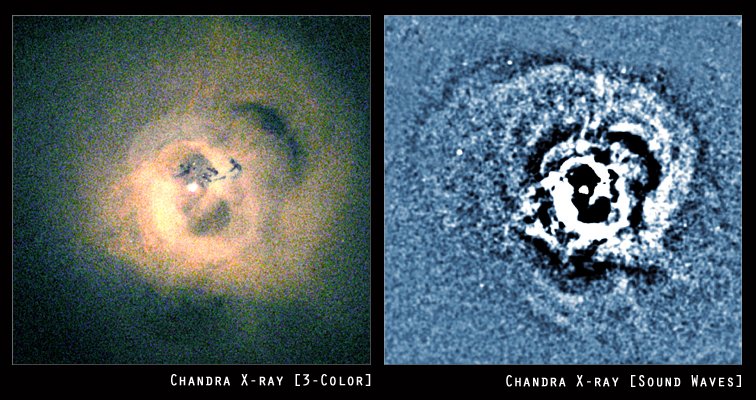
The widely shared “black hole sound” from the Perseus galaxy cluster has a more specific physical basis. According to the Chandra sonification description, pressure waves associated with the central black hole produce ripples in the cluster’s hot gas. Gas supplies a medium in which those waves can propagate.
For the audio presentation, the team extracted signals in outward directions and resynthesized them at frequencies raised by 57 and 58 octaves. That enormous shift brings the representation into human hearing. It is not an unaltered microphone recording made beside a black hole.
The distinction is useful: there can be physical sound in a gas-filled environment even when its natural frequencies are inaudible to people. Turning those measurements into audible sound is still a transformation that should be explained. It does not make every space sonification a recording of pressure waves.
Three questions to ask before interpreting a clip
What was measured? Look for the actual instrument and quantity: microphone pressure changes, X-ray brightness, an optical spectrum, or something else. “NASA data” is an origin label, not a measurement description.
What controls the audio? Find out whether pitch represents a shifted physical frequency, image position, brightness, or another variable. Different projects can assign different meanings to the same audible feature.
What does playback time represent? A ten-second clip might traverse a static image, compress a long observation, or present ten seconds of a recording. Without that information, a rising note cannot establish that an object is accelerating or becoming more energetic.
Try applying those questions to M104 and Perseus. The first maps multiwavelength image information into an audio sequence. The second makes inferred gas-pressure waves audible through a huge frequency shift. Neither needs to be mistaken for a nearby microphone recording to be scientifically interesting.