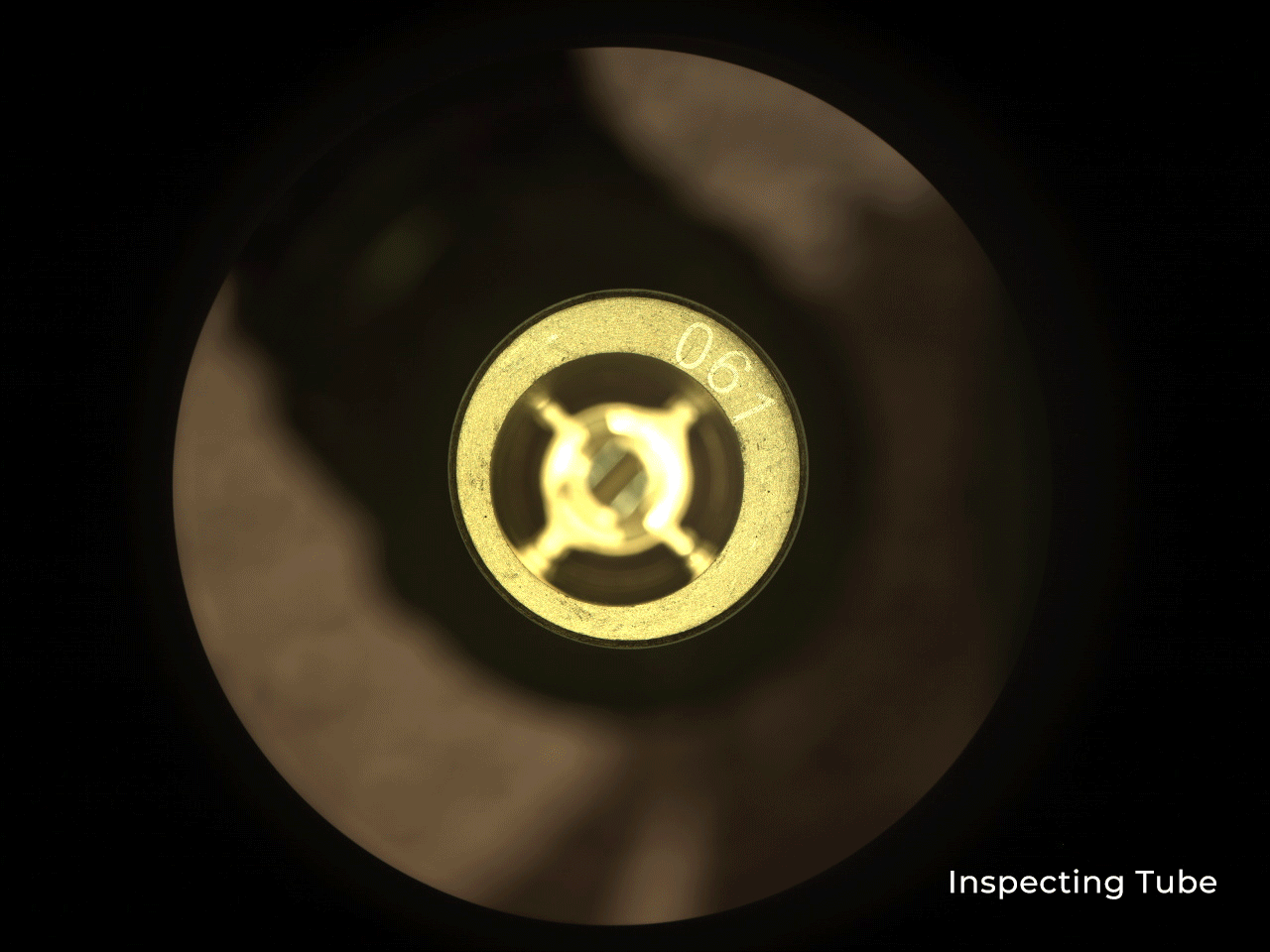
Perseverance’s witness tubes help scientists investigate Mars sample contamination by recording material that could accompany sample collection without coming from the sampled rock. They are controls for interpreting possible Earth-derived contamination. A clean witness result would not, by itself, prove that a substance in a Mars sample came from life.
This is why carrying a tube that is not meant to collect a rock core can be scientifically valuable. The question is not only “What did the instrument detect?” It is also “How could that material have reached the sample?”
What a witness tube collects
Perseverance was equipped with 43 tubes, including five witness tubes. Unlike the rock-sampling containers, the witnesses were preloaded with materials designed to capture molecular and particulate contaminants. NASA’s rover documentation identifies potential contaminants including gases released by spacecraft materials, remnants of the landing propulsion system, and other material brought from Earth.
Witnesses therefore have a different job from a drilled core. They help characterize the collection environment and possible contamination pathways. They are not extra Mars rocks, and they are not a general census of Martian organisms.
The original tube allocation is a design fact. It should not be confused with the number of tubes filled, carried, or deposited at any particular stage of the mission.
Why cleaning alone is not the whole answer
NASA’s account of the sample tubes’ preparation describes repeated cleaning, contamination measurements, and extensive documentation before launch. It also explains that the witness tubes were designed to be opened individually on Mars, primarily near sample collection sites.
Those steps answer different questions. Prelaunch checks establish what engineers could measure before departure. Witness exposures provide evidence about later conditions. A record from the factory cannot, by itself, describe everything that might happen during landing and sampling.
Calling equipment “clean” is consequently incomplete without knowing what was tested and how sensitively. A measurement can establish a limit on detectable contamination; it cannot establish the absolute absence of every molecule. The aim is to make contamination traceable enough to evaluate scientifically.
How to interpret a sample and its control
Consider three hypothetical outcomes. These are examples of analytical reasoning, not reported results from returned Perseverance samples.
A compound appears in both a rock sample and a relevant control. Contamination becomes an explanation that needs investigation. Scientists would compare amounts, chemical signatures, exposure histories, and the analytical procedure. A matching detection does not automatically establish that every molecule in the rock sample is contamination.
A compound appears in the rock sample but is not detected in the control. That weakens the particular contamination explanation tested by that control. It does not eliminate pathways the control did not represent, or contamination below the test’s sensitivity. “Not detected” needs a detection limit.
Neither analysis detects the compound. The experiment has not found that target under those conditions. It has not demonstrated that the entire rock contains no organic chemistry, much less that Mars never supported life.
This comparison shows why a control is evidence with a scope, rather than a pass-or-fail certificate. The sampling history and the laboratory method belong alongside the chemical result.
Establishing origin is different from establishing life
Even a confidently Martian organic molecule would need an explanation for how it formed. Organic chemistry can occur without organisms. NASA’s life-detection framework treats contamination checks, reliable measurements, and nonbiological alternatives as parts of a larger evidentiary problem.
Two separate tests are involved: could the material have arrived from Earth, and could Martian nonliving chemistry produce it? Resolving the first does not automatically resolve the second. The same broader caution applies when interpreting oxygen as a possible exoplanet biosignature, although atmospheric observations and laboratory sample controls are very different methods.
What the tubes could enable
If Perseverance samples are returned to Earth, the witness tubes could help laboratories distinguish spacecraft-associated contaminants from material belonging to the samples. That is a conditional scientific purpose, not a promised return date or a claim that those analyses have happened.
For a future sample headline, look for the control results, the contamination history, and the alternative chemical explanations alongside the exciting detection. Witness tubes matter because they help turn “we found something” into a more demanding question: what does the finding actually show?