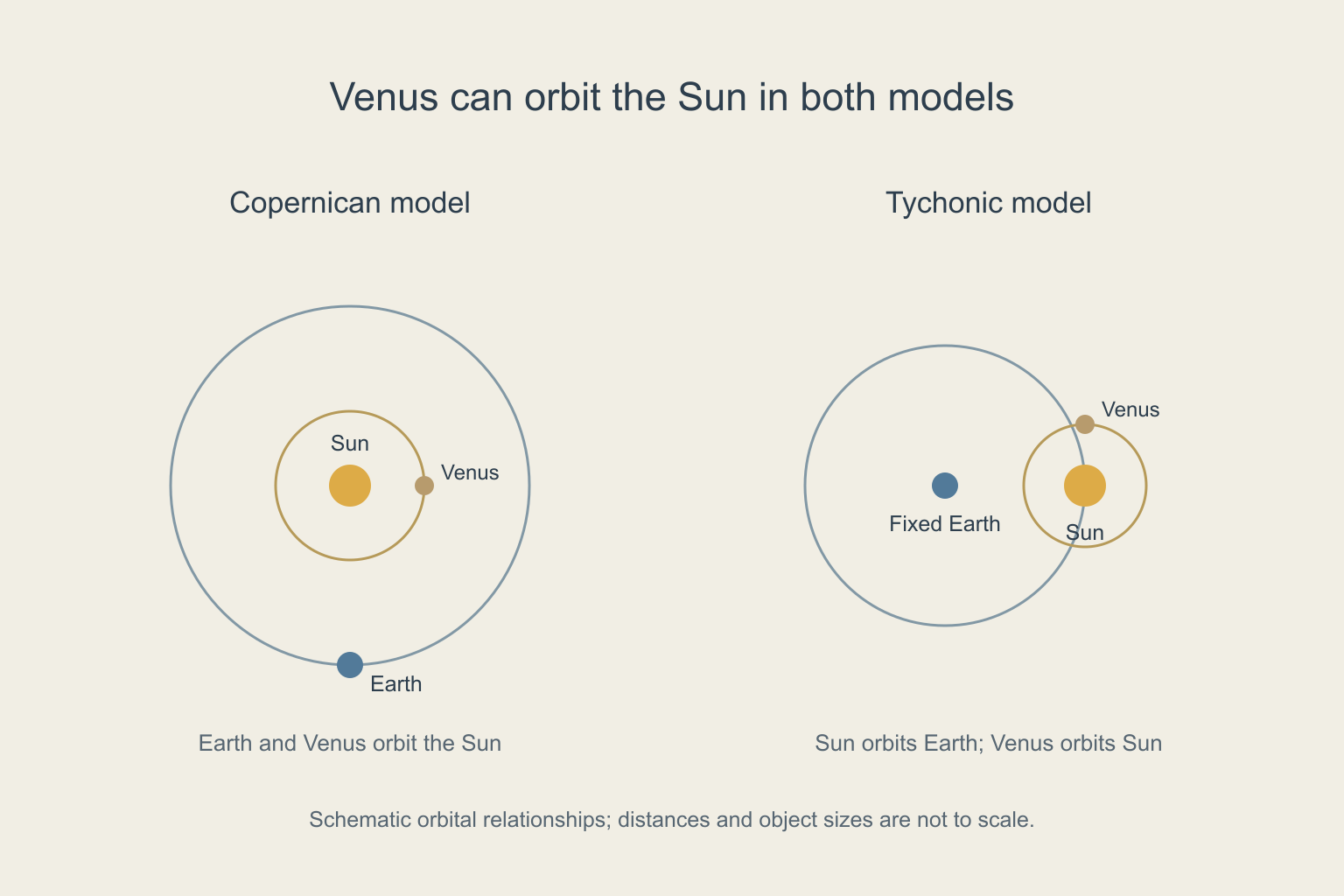
Venus’s phases showed that the standard Ptolemaic arrangement could not explain what telescopes revealed. They supported a path around the Sun, including positions beyond it as seen from Earth. But the phases alone did not prove that Earth moves: Tycho Brahe’s alternative model could reproduce them while keeping Earth stationary.
That distinction makes Galileo’s observation more instructive, not less important. One observation can rule out a particular model without choosing uniquely among all the models left standing.
What changes when Venus becomes a crescent
Venus shines by reflected sunlight. Its phase describes how much of its illuminated half faces us. A thin crescent and a nearly full disk are different viewing geometries, not evidence that the Sun alternately lights a small and a large fraction of the planet.
Apparent size changes too. Venus generally presents a larger crescent when it is closer to Earth and a smaller, more fully illuminated disk when it is farther away. NASA’s archived Venus explanation describes Galileo following this change from a small, nearly round appearance toward a larger crescent.
Rotation is a separate question. The phase sequence is not a clock measuring one spin of Venus; the distinction between its rotation and solar day is explained in our guide to the length of a Venusian day.
Why the standard Ptolemaic arrangement failed
In the conventional Ptolemaic arrangement, Venus remained on the near side of the Sun. That geometry could not reproduce the observed range extending to gibbous phases, in which more than half of Venus’s visible disk is illuminated.
The important test is therefore not merely “Does Venus have a crescent?” It is whether a model permits the full observed sequence. A crescent alone leaves more possibilities open than the sequence of changing phase and size does.
The Galileo Project at Rice University documents how astronomers at the Collegio Romano confirmed the phases and how Christopher Clavius recognized the need to reconsider the arrangement of the celestial bodies. Agreement that the phenomenon was real did not instantly produce agreement about the whole planetary system.
Why Tycho’s model could also fit the phases
NASA’s history of planetary orbits describes Tycho’s arrangement: the other planets orbit the Sun, while the Sun orbits a stationary Earth. It is often called a geoheliocentric model because it combines Earth-centered and Sun-centered motions.
For Venus’s phases, the relevant geometry is the relative placement of Earth, Venus, and the Sun. Letting Venus circle the Sun permits both near-side crescents and far-side gibbous appearances. This works whether the larger model also has Earth orbiting the Sun or instead has the Sun moving around Earth.
The observation consequently discriminated between the standard Ptolemaic configuration and these alternatives. It did not discriminate between Copernicus and Tycho on its own. That is a limit on this particular test, not a suggestion that modern astronomy regards Earth’s orbital motion as unresolved.
A three-model test you can follow
Imagine drawing the same Sun–Venus–Earth triangle three times. Shade the half of Venus facing away from the Sun, then examine the disk from Earth’s position. This is a paper geometry exercise, not an observing instruction.
Ptolemaic test: impose the traditional restriction that keeps Venus on the near side of the Sun. Can the construction produce the required gibbous views? The restriction is the problem.
Copernican test: let Venus orbit inside Earth’s orbit. The changing triangle permits the observed phase range.
Tychonic test: keep Earth fixed, move the Sun around it, and keep Venus orbiting the Sun. The triangle can still have the same relative shapes. The phase evidence therefore does not eliminate this alternative.
The useful habit is to ask what each model predicts for the actual measurement. “Supports heliocentrism” and “alone proves Earth’s motion” make different claims. Venus’s phases were powerful evidence because they forced a specific astronomical arrangement to change; their historical importance does not require giving them more logical reach than they had.