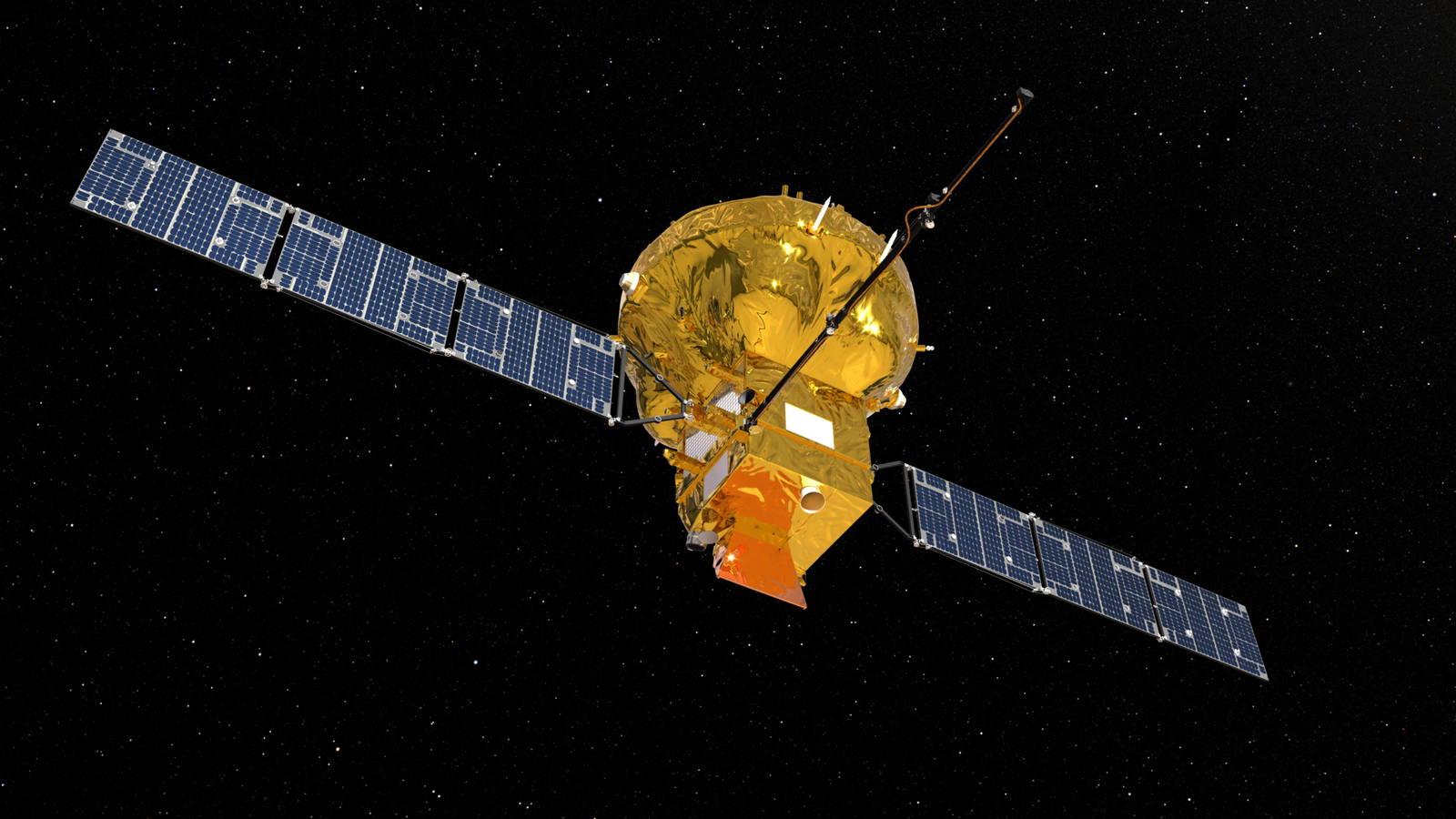
Cover: AI-generated illustration for Galileo Whispers, adapted from Smile spacecraft (artist impression) (ESA; work performed by ATG under contract to ESA). Conceptual mission scene, not a science observation. CC BY-SA 3.0 IGO.
Smile is designed to study Earth’s magnetosphere by detecting soft X-rays produced when charged particles from the solar wind interact with neutral gas near Earth. The pattern of that emission can help researchers infer the position and shape of magnetic boundaries. It is not a direct photograph of magnetic field lines.
The joint European Space Agency and Chinese Academy of Sciences mission combines that distant view with ultraviolet images of auroras and measurements taken beside the spacecraft. Together, these observations address a persistent difficulty in space physics: connecting changes in one location with the behavior of a much larger system.
The boundary Smile is trying to trace
Earth’s magnetosphere is the region where our planet’s magnetic field strongly influences the surrounding charged particles. The solar wind presses against it and helps shape it. On the Sun-facing side, the magnetopause is the boundary separating the magnetosphere from the surrounding solar-wind plasma.
That boundary is not a solid surface. Its position and shape respond to changing conditions. Outside it lies the magnetosheath, a region of solar-wind plasma that has passed through the bow shock. Near the polar regions, the cusps provide additional access for solar-wind particles.
A spacecraft carrying a magnetometer can measure the magnetic field where it travels. That local reading is valuable, but it does not immediately show what the entire boundary was doing at the same moment. ESA’s explanation of Smile’s X-ray method describes the motivation for adding a wide view to those point measurements.
Why interactions near Earth produce soft X-rays
The solar wind contains ions: atoms that have lost electrons and carry an electric charge. Near Earth, some highly charged ions encounter neutral atoms in the extended upper atmosphere, or exosphere. An ion can capture an electron from a neutral atom. As the captured electron settles into a lower-energy state, the ion can emit X-rays.
This process is called solar wind charge exchange. “Soft” identifies relatively low-energy X-rays; it does not mean the light is visible or that the emission is an ordinary photograph of an aurora.
The relevant emission is concentrated in regions where solar-wind ions and neutral atoms overlap, including the magnetosheath and cusps. Smile’s Soft X-ray Imager, or SXI, is designed to collect that light. Researchers then use the brightness pattern, viewing geometry, and physical models to estimate the boundary’s location.
The distinction matters: the detector records photons. The boundary is inferred from the distribution of those photons and an explanation of where they came from.
Four instruments answer different questions
Smile’s science toolbox includes two imagers and two instruments that make measurements near the spacecraft. Their roles complement one another.
| Instrument | What it measures | Why that is only part of the picture |
|---|---|---|
| Soft X-ray Imager, SXI | Soft X-ray brightness across its field of view | Boundary geometry must be reconstructed from emission, not read directly as magnetic field strength |
| Ultraviolet Imager, UVI | Ultraviolet light from the northern auroral region | An auroral image does not replace a measurement of the upstream solar wind |
| Light Ion Analyzer, LIA | Properties of ions near the spacecraft | A local particle sample does not describe every part of the magnetosphere |
| Magnetometer, MAG | The magnetic field near the spacecraft | A point measurement needs context when interpreting a global response |
For example, a change in X-ray brightness and a change in the auroral pattern might be related to the same solar-wind disturbance. The local instruments provide additional information for testing that explanation. Simultaneous changes are useful clues, but the physical connection still has to be established.
Why a brighter image does not have just one explanation
The Smile Modeling Working Group’s review explains that the emission depends on particle densities, neutral gas, relative motion, and viewing geometry. An image collects light along each line of sight, so different three-dimensional arrangements can contribute to the same two-dimensional brightness pattern.
Consider a hypothetical observation in which part of an image becomes brighter. The boundary might have moved, but the emission could also have strengthened because the particle conditions changed. Treating brightness alone as a ruler would risk confusing those effects. Researchers compare plausible models and other measurements to narrow the interpretation.
That is why global imaging and local sampling are partners. One supplies spatial context; the other helps constrain conditions that an image alone cannot uniquely determine.
What the 2026 commissioning report actually established
In its September 30, 2026 announcement, ESA reported that Smile had been cleared for science operations on September 23. Ultraviolet auroral footage had been released, while SXI had taken test images of a distant supernova remnant. The same report described excess unwanted light when SXI pointed toward Earth.
ESA expected more favorable conditions around mid-October. That was a forecast in the September report, not evidence that the expected magnetopause image had already been obtained. The dated account illustrates an important distinction: a camera can function on a test target while still requiring work to extract a faint signal under different observing conditions.
Unwanted light should also not be confused with every other source of instrumental background. Our explanation of why infrared telescopes need to stay cold describes thermal emission and detector noise in a different setting. It is not a prescription for solving SXI’s stray-light problem.
What to look for in a magnetosphere image
A useful interpretation should identify the instrument, observation time, viewing direction, and whether a boundary is measured locally or reconstructed from an image. It should also distinguish calibrated observations from simulations and illustrations.
For Smile, the enduring scientific opportunity is to connect the solar wind, the magnetosphere’s changing shape, and the auroral response. Soft X-rays make one part of that system observable from a distance; the mission’s other instruments and physical models help determine what the image means.
Updated October 21, 2026: Expanded the original mission report into an explanation of soft X-ray imaging and retained the September 2026 commissioning account as dated context. The original publication date is retained.

