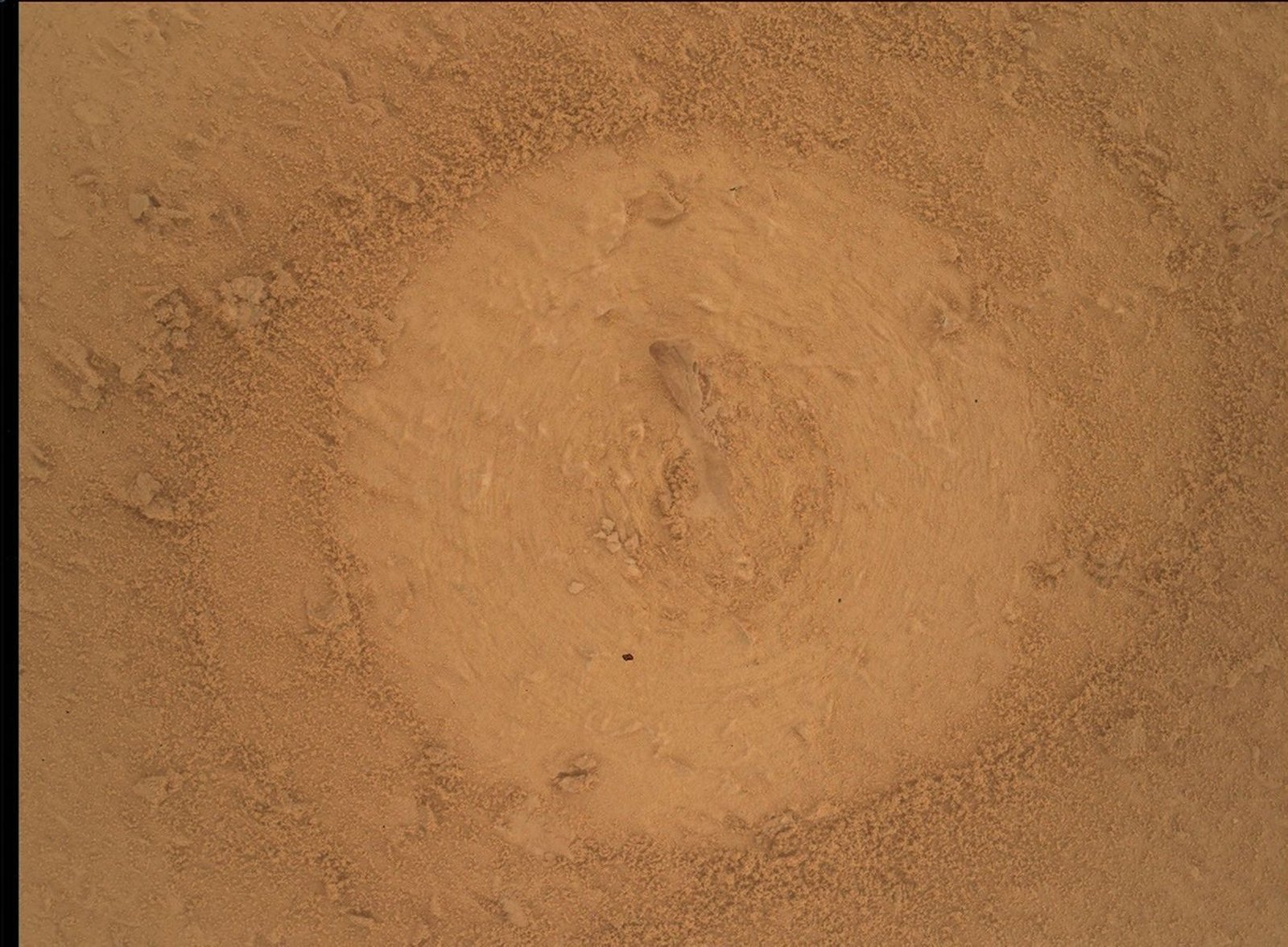
NASA's Curiosity team reports a successful drill at Basque Lakes, the rover's 48th drilled rock target on Mars. The mission update describes preparation for laboratory analysis; it does not announce the sample's final mineral composition or evidence of life.
The NASA mission blog, published October 4, 2026, carries an Earth planning date of September 25. That distinction matters: October 4 is the report's publication date, not an established date for the drilling operation.
What the team completed
Writing for the mission, researcher Lucy Thompson describes successful drilling at Basque Lakes in the Cache Creek area of Gale Crater. Before drilling, the team assessed the target with close-up imaging and chemical measurements and checked its stability under pressure from the drill.
The update's lead image shows that pre-drilling stability check. It should not be mistaken for a photograph documenting the completed borehole. A rover image can be relevant to an operation without depicting its final stage.
The name “Basque Lakes” identifies a rock target. It is not an announcement that Curiosity found a lake there.
Why one sample goes through different tests
The rover's instruments address different questions. NASA's Curiosity instrument guide explains their roles.
APXS measures elemental composition. ChemCam can use a laser and the resulting light to investigate chemistry. Those measurements help characterize a target, but knowing its elements does not uniquely establish how those elements are arranged in minerals.
CheMin uses X-ray diffraction to identify minerals in powdered material. SAM analyzes gases, including gases released as a sample is heated, to investigate chemical composition. Combining those methods makes the sample more informative than a photograph or a single elemental reading alone.
For an everyday analogy, an ingredient list and a description of a finished material answer related but different questions. Neither automatically replaces the other. The laboratory instruments likewise provide complementary evidence, rather than several interchangeable versions of the same test.
Which results remain outside this announcement?
At the September 25 planning point, the team scheduled CheMin analysis and anticipated a later delivery to SAM. Those were planned steps in the report. The elapsed time since that plan is not sufficient evidence that every step succeeded or that a particular result was obtained.
A later scientific conclusion would need the actual measurements, their interpretation, and relevant uncertainty. The drilling milestone establishes access to a new sample; it does not, by itself, establish a new history of water or a biological origin for anything in the rock.
The broader principle is familiar from how spectra reveal chemical clues: obtaining a signal, identifying its source, and interpreting what it means are separate tasks. Basque Lakes now has a reported drilling milestone. Its scientific interpretation must follow the evidence the mission releases, not assumptions attached to the target's name or the success of the drill.