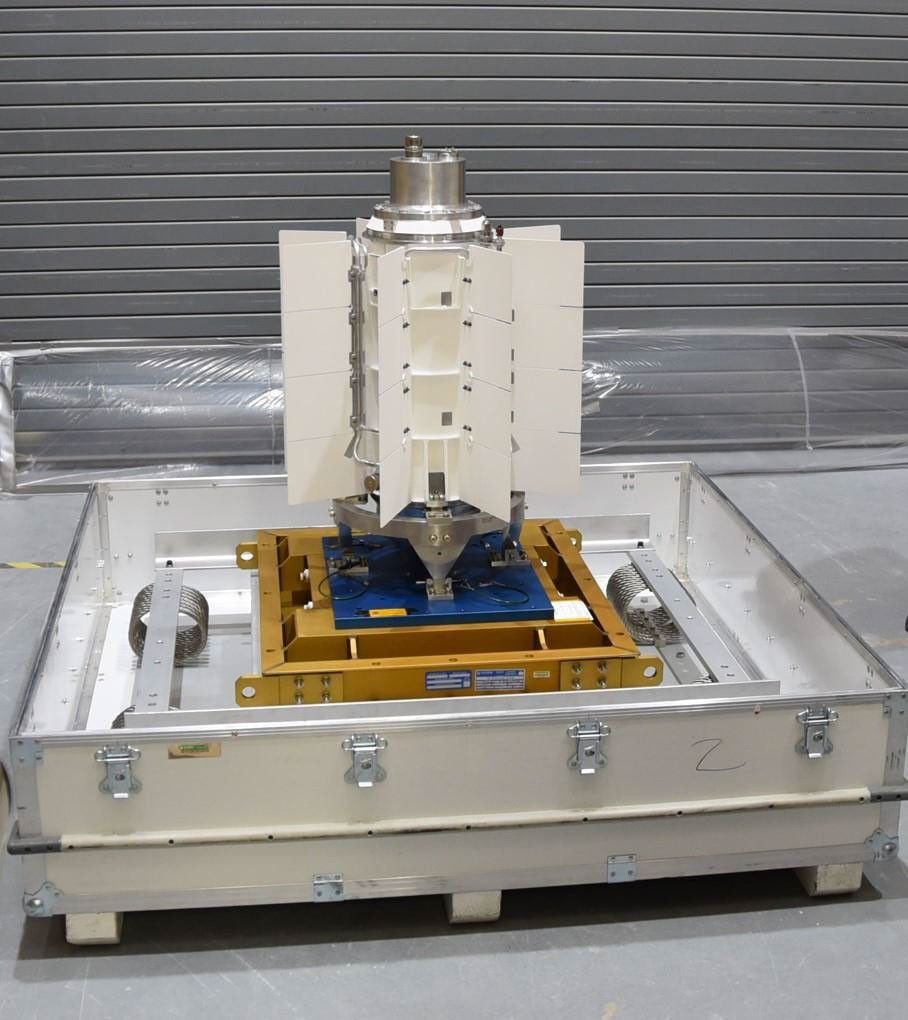
A radioisotope thermoelectric generator, or RTG, makes electricity from the heat released by radioactive decay. It does not sustain the controlled fission chain reaction used by a nuclear reactor. Both involve nuclear energy, but they obtain and manage that energy differently.
An RTG is also a power source, not a rocket engine. It can keep instruments, computers, and other electrical systems operating far from sunlight without supplying the propulsive thrust that changes a spacecraft's trajectory.
From plutonium decay to an electrical circuit
NASA's RTGs use plutonium-238 as a heat source. Its nuclei decay naturally, releasing energy that heats the surrounding material. Thermoelectric elements convert part of that heat flow into electricity through a temperature difference between their hot and cold sides.
NASA's RTG description explains the conversion through thermocouples. The hot side receives energy from the fuel, while the cooler side sheds heat to its surroundings. The conversion does not require a turbine or moving piston.
“No moving parts” describes the thermoelectric conversion system. It does not mean the entire spacecraft has no moving mechanisms, needs no thermal design, or will work forever.
What a reactor does differently
A fission reactor obtains heat from nuclei splitting in a sustained chain reaction. Neutrons from one fission can cause further fissions, and the system is designed to control that process. NASA's technical comparison of radioisotope decay and fission distinguishes the natural decay rate of plutonium-238 from a reactor's controllable reaction rate.
Switching off an RTG-powered instrument therefore does not switch off the radioactive heat source. It reduces electrical demand. The generator must still manage the continuing heat flow.
This is why “nuclear battery” is a useful but incomplete nickname. An RTG does not wait for a load to be connected before its isotope decays, and it is not recharged by plugging it into sunlight.
Why 2,000 watts of heat do not mean 2,000 watts of electricity
NASA's radioisotope-power overview describes a general-purpose heat-source module as supplying about 250 watts of thermal power. The program FAQ states that an MMRTG uses eight such modules and is designed to supply about 110 watts of electrical power at the beginning of a mission.
Using those rounded design figures, eight times 250 gives approximately 2,000 watts of heat. Dividing 110 by 2,000 gives about 5.5% converted into electricity. The rest remains heat that must be dissipated or, where useful, directed toward keeping spacecraft components warm.
This calculation is a design-point illustration, not a measurement of an operating rover. Thermal watts and electrical watts share the unit of power, but they describe different parts of the energy budget. Comparing them as if they were interchangeable overstates what the instruments can use.
Why the available power declines
Radioactive decay gradually reduces the number of plutonium-238 nuclei available to release energy. Its half-life is about 88 years. Half-life is not a shutdown date: after one half-life, half the original nuclei remain, and decay continues.
A mission's usable electrical output must also be considered in the context of its conversion system and thermal conditions. The isotope's half-life alone is not a promise that every instrument can run unchanged for that long.
Turning off a load can help fit the remaining electrical supply, but it does not pause the isotope's clock. A spacecraft's operating lifetime also depends on hardware, communications, and mission decisions beyond the heat source.
Why not put an RTG on every spacecraft?
RTGs are useful when darkness, dust, long nights, or weak sunlight make solar power difficult for a mission's requirements. NASA selects radioisotope systems when they enable or substantially improve the science and operations; they are not a universal replacement for solar arrays.
The choice involves power demand, mass, thermal behavior, fuel availability, and the destination. A mission needing far more electrical power cannot assume that a single rover-scale generator will suffice just because the source is nuclear.
Keep three quantities separate when reading spacecraft specifications: heat produced, electricity delivered, and thrust generated. Our delta-v explanation covers the velocity changes associated with propulsion, while reaction wheels illustrate how electrical power can support pointing without providing translational thrust.