Delta-v means a change in velocity: a change in speed, direction, or both. In mission planning, a delta-v budget describes the maneuvers a spacecraft must perform, while its available delta-v describes its propulsion capability under stated assumptions. Neither number is the spacecraft’s current speed or its maximum possible speed.
That distinction explains how a spacecraft can travel quickly while having little maneuvering capability left—and why slowing down can consume propellant.
Velocity includes direction
Speed answers “how fast?” Velocity also answers “which way?” NASA Glenn’s explanation of vectors makes this distinction explicit. A spacecraft moving at 1 kilometer per second eastward has a different velocity from one moving at the same speed northward.
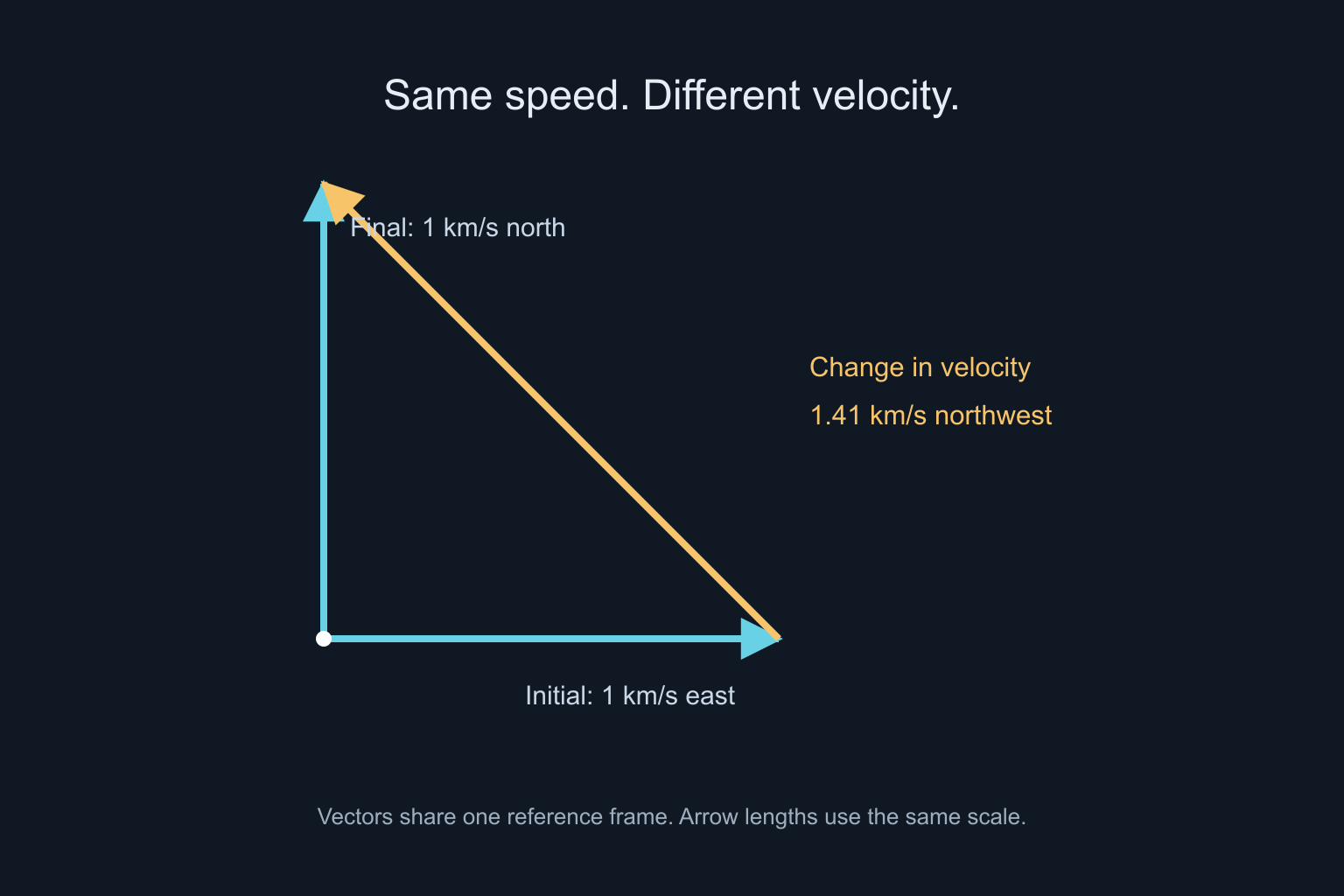
For a single idealized maneuver, subtract the initial velocity vector from the final one. The size of that difference is the maneuver’s delta-v. Subtracting the two speedometer readings would miss a change in direction.
Consider a hypothetical right-angle turn: 1 km/s east before the maneuver, 1 km/s north afterward. The velocity change has a westward component of 1 km/s and a northward component of 1 km/s. Its magnitude is approximately 1.41 km/s, even though the speed stays at 1 km/s. This is a vector calculation, not a practical trajectory or a claim that real engines turn a spacecraft instantaneously.
A maneuver budget is not the final minus the starting speed
Imagine an isolated spacecraft, initially at rest in a chosen reference frame. Ignore gravity and all other external forces. A short burn accelerates it to 100 meters per second. A later, opposite burn returns it to rest.
The two maneuvers require 100 m/s each, for a total budget of 200 m/s. The net velocity change over the entire exercise is zero. Returning to the original velocity does not return the expended propellant.
This example separates three quantities that otherwise look deceptively similar: the cost of each maneuver, the sum of those costs, and the difference between the initial and final velocities. A mission budget generally adds maneuver requirements, including allowances for corrections, rather than subtracting two endpoint speeds.
Braking is therefore a real propulsion task. At a destination, orbital insertion may require reducing the spacecraft’s speed relative to the planet so that it enters a bound orbit instead of continuing past.
What the rocket equation actually tells you
The ideal rocket equation connects propulsion capability to exhaust velocity and the mass consumed:
Delta-v = effective exhaust velocity × ln(initial mass ÷ final mass).
Here “ln” means the natural logarithm. Both masses include the spacecraft and whatever remains aboard at the relevant endpoint. The final mass excludes propellant already expelled; it does not mean the payload alone.
For a hypothetical effective exhaust velocity of 3 km/s and an initial-to-final mass ratio of 2, the result is 3 × ln(2), or about 2.08 km/s. This example assumes constant effective exhaust velocity, one propulsion stage, and no external forces. It is a capability calculation, not a prediction of the speed displayed during an actual launch.
The logarithm also matters. Raising the mass ratio from 2 to 4 doubles this ideal delta-v, because ln(4) is twice ln(2). It does not double the payload. The mass being accelerated must include the vehicle, its payload, and the propellant still needed later.
Gravity changes velocity too
NASA’s spaceflight mechanics guide states the no-external-forces condition for the ideal propulsion calculation. Real trajectories include gravity; launches also encounter atmospheric drag. A spacecraft coasting in an orbit continually changes velocity even with its engines off.
Mission designers distinguish those natural trajectory changes from the maneuver capability supplied by propulsion. A gravity assist can reshape a trajectory without an equivalent engine burn, but it requires the right encounter geometry. It is not a refill of the spacecraft’s propellant tank.
When you encounter a delta-v figure, ask what it describes: a particular burn, a route’s maneuver requirement, or the capability remaining aboard. Then check the reference frame, the trajectory assumptions, and whether losses or reserves are included. Those details make the number useful; the number alone is not a speed limit.