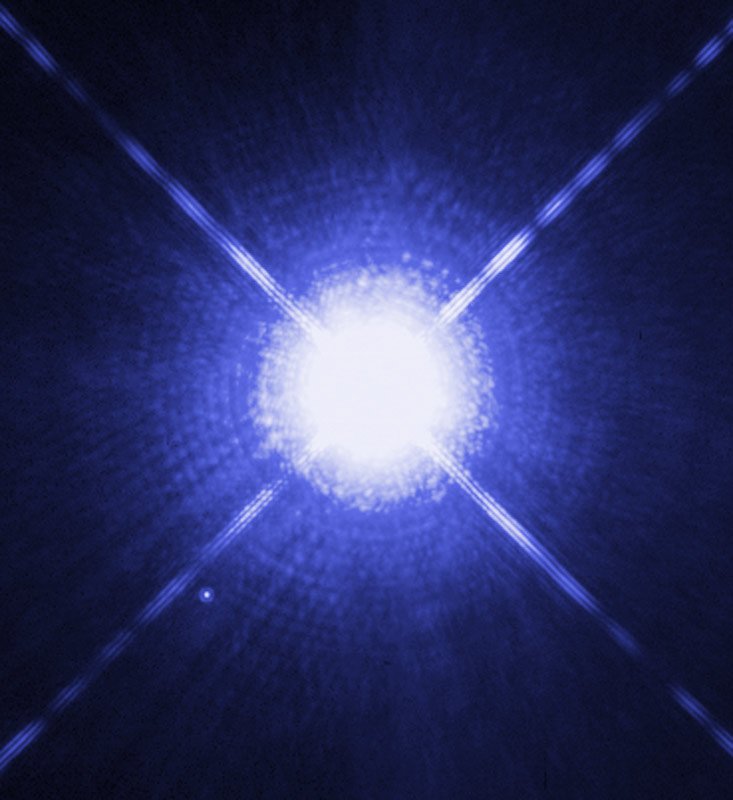
One of the most direct ways to measure the mass of a star is to watch it orbit a companion. The orbit’s size and period reveal the pair’s combined mass. Measuring how the two stars share that motion can then separate the total into individual masses.
Brightness alone cannot do the same job. A star can look faint because it is far away, obscured, or intrinsically dim. Orbital motion supplies a different kind of evidence: the gravitational effect of mass.
The orbit acts as a measurement
Both stars in a binary system move around a shared center of mass. A more massive pair needs faster orbital motion to maintain the same separation. Conversely, the same orbital period can support a larger orbit if the total mass is larger.
Newton’s version of Kepler’s third law makes that relationship quantitative. Using astronomical units for distance, years for time, and solar masses for mass, it becomes:
Combined mass = a³ ÷ P².
Here, a is the semimajor axis of one star’s orbit relative to the other, not either star’s individual orbit around the center of mass. P is the orbital period. A solar mass is the mass of our Sun; one astronomical unit is approximately the Earth–Sun distance.
Consider a hypothetical binary with a relative semimajor axis of 4 AU and a period of 8 years. Its combined mass is 4³ ÷ 8² = 64 ÷ 64 = one solar mass. This is a teaching example, not a measurement of a named system.
How the total becomes two individual masses
The more massive star follows the smaller orbit around the center of mass. If one star’s orbit is twice the size of its companion’s, it has half the companion’s mass. Combining that ratio with the total gives the individual values.
For the hypothetical one-solar-mass pair, that 2:1 orbital-size ratio would correspond to masses of about one-third and two-thirds of a solar mass.
Astronomers obtain orbital information in different ways. Repeated images can trace changing positions. Spectra can reveal alternating motion toward and away from Earth. Eclipses can help constrain the orientation. OpenStax’s stellar-mass chapter explains how these observations work together. Our article on spectrographs and starlight provides background on reading spectral information.
Why an accurate distance changes the answer
Images measure angular separations on the sky. The same angular orbit represents a larger physical orbit if the system is farther away. For a visual binary with its period and fitted orientation held fixed, that matters strongly because the inferred total mass scales with the cube of the physical semimajor axis.
In an illustrative calculation, increasing the adopted distance by 10% increases that axis by 10%. The resulting mass changes by 1.1³ = 1.331, about 33%, rather than just 10%. This is a sensitivity example, not a claim about Sirius’s distance error. It shows why measuring a neat-looking orbit is not enough: its physical scale must also be established.
Sirius offers a real example
In a 2017 study, Howard Bond and colleagues combined Hubble observations, ground-based measurements, and historical records to determine the orbit of Sirius A and its white dwarf companion, Sirius B.
Their reported dynamical masses were 2.063 ± 0.023 solar masses for Sirius A and 1.018 ± 0.011 solar masses for Sirius B. The uncertainties matter: these are estimates derived from observations and an orbital model, not exact counts of material. The study also used the system’s distance, measured through parallax, to turn angular motion on the sky into a physical orbit.
What can make the measurement uncertain?
A projected ellipse on the sky is not automatically the true orbit. Astronomers must account for its tilt, distance, and how much of the orbital cycle has been observed. Spectroscopic measurements alone generally leave an ambiguity involving inclination unless other evidence constrains it.
For isolated stars, masses often depend more heavily on models and comparisons with well-measured stars. Binary systems are valuable because their orbital masses let researchers test those models against gravity-based measurements. A published stellar mass is most informative when its method and uncertainty accompany the number.
What about a star without a measurable companion?
A luminosity-based estimate uses a relationship calibrated from other stars, rather than an observed two-body orbit. The mass–luminosity relationship introduced by OpenStax is useful within its applicable stellar population; it is not one universal conversion for every star. The chapter’s white-dwarf outliers illustrate that limit. Knowing which kind of star is being compared matters as much as inserting a brightness into a formula.