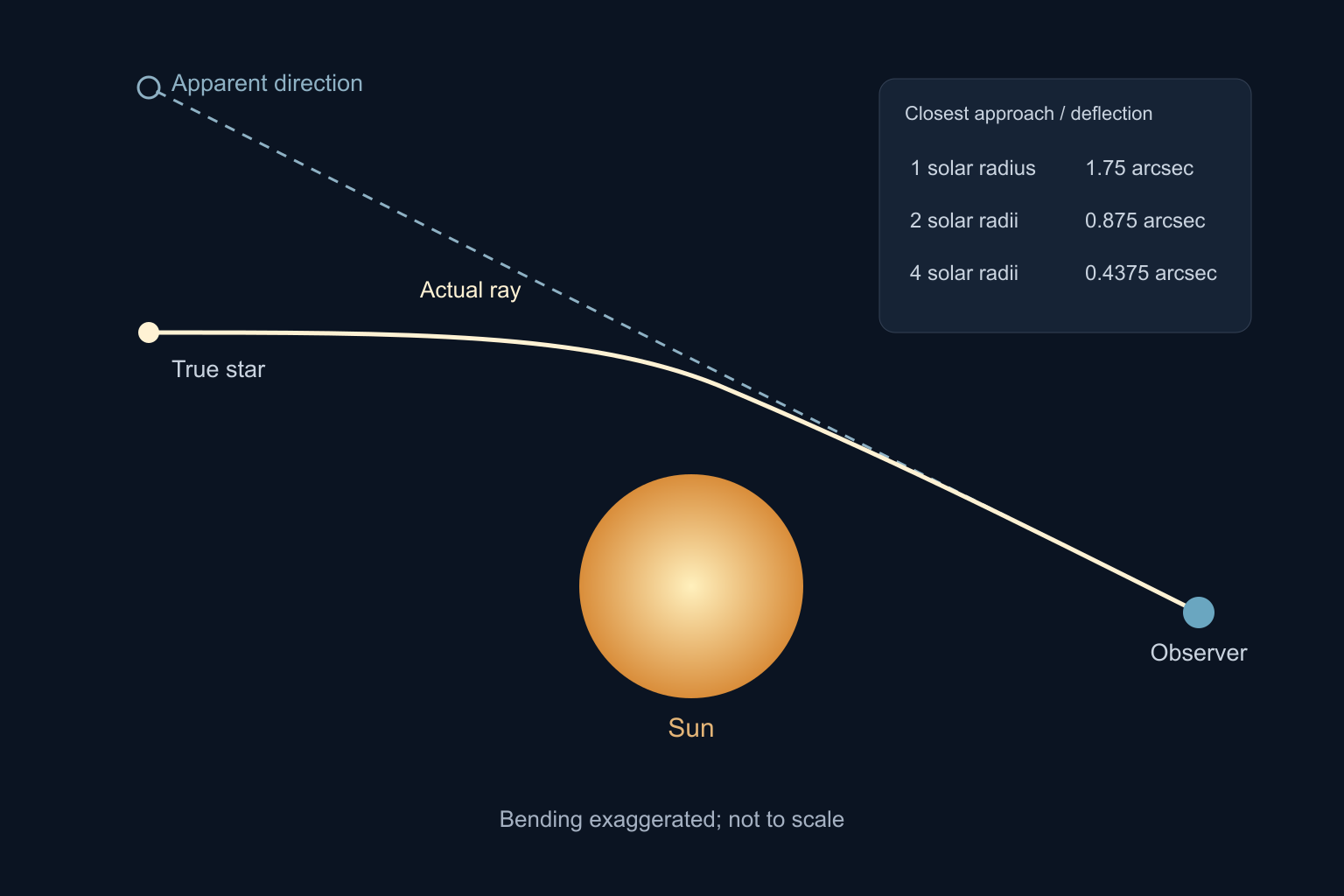
Light from a distant star passing just outside the Sun's visible edge is deflected by about 1.75 arcseconds in general relativity. That is roughly 0.00049 degrees. In the same weak-field approximation, doubling the ray's distance from the Sun's center halves the bending.
The small angle is measurable, but interpreting it requires care: the relevant distance starts at the Sun's center, and a shifted image does not mean the background star physically moved.
What the 1.75-arcsecond prediction describes
NASA's explanation of the light-deflection test gives the familiar solar-limb value. One arcsecond is 1/3,600 of a degree. Dividing 1.75 by 3,600 puts the tiny deflection into more familiar angular units.
The number refers to a grazing light path and a particular geometry, not to every star seen near the Sun or every ray passing a gravitating object. A more distant path bends less. Nor is 1.75 arcseconds a physical displacement in kilometers: converting an angular shift into a transverse distance requires additional geometry.
The NASA page was prepared for the 2017 eclipse. Its relativity calculation remains useful as an evergreen example; its observing dates and star-field instructions are historical.
A calculation at two and four solar radii
For this solar example, the approximation can be written:
Deflection in arcseconds ≈ 1.75 × solar radius / impact parameter.
The impact parameter describes the offset of the incoming, initially straight ray from the center. In this weak-deflection example, it is approximately the closest-approach distance. Einstein Online's light-deflection discussion explains the inverse-distance behavior.
At one solar radius, the expression gives 1.75 arcseconds. At two solar radii, it gives 0.875 arcseconds, or about 0.88. At four solar radii, it gives 0.4375 arcseconds, or about 0.44.
The distinction between center and surface prevents an easy mistake. A path one solar radius above the visible surface is about two solar radii from the center. It belongs to the second example, not the first. These values are illustrative calculations using a rounded reference value, not new observations.
The approximation assumes a nearly spherical mass and weak deflection. It cannot be carried unchanged into a black hole's immediate surroundings or applied to an extended galaxy by inserting a convenient “radius.”
Why the star appears farther from the Sun
The telescope records the light's arrival direction. Trace that direction backward as if the ray had traveled straight, and the inferred position lies away from the star's unlensed position. In the simple solar geometry, the apparent displacement is outward from the Sun.
Einstein Online's introduction to light deflection connects the curved trajectory with this apparent-position effect. The light bends toward the gravitating body along its route, yet the background star's inferred position can shift outward. Those statements describe different parts of the geometry and are consistent.
For the reason light responds to gravity despite having zero rest mass, our equivalence-principle guide introduces the connection between local acceleration, free fall, and curved spacetime.
A prediction is easier than a precise measurement
The arithmetic above needs only a ratio. An observational test must distinguish a very small position change from atmospheric and instrumental effects, calibrate the image scale, and establish reference positions.
ESA's account of relativity and the 1919 eclipse describes the difficulty of early eclipse measurements and later confirmation with precise astrometry. A numerical prediction should not be presented as if it were the uncertainty of a measurement.
On larger astronomical scales, maps inferred from gravitational lensing involve a further task: reconstructing the distribution of matter responsible for many deflected rays. The solar example isolates one useful relation. A real lens map must account for the full system, its measurements, and their limits.