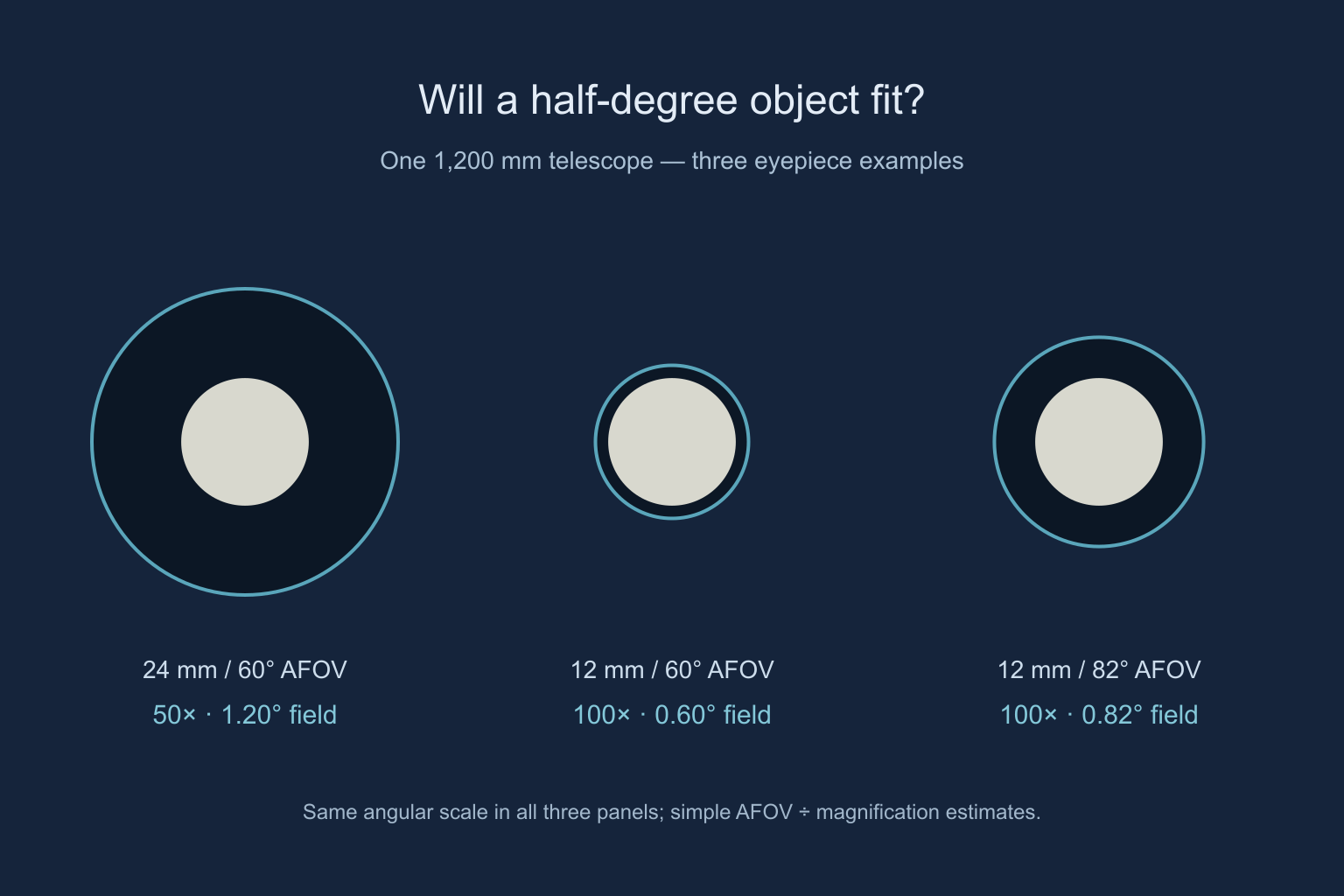
To estimate a telescope’s true field of view, divide the eyepiece’s apparent field by the magnification. Compare that angular width with the target’s apparent size on the sky. The result tells you approximately what fits in the view, not how much detail you will see or how bright the target will appear.
Two eyepieces can produce the same magnification and still show different amounts of sky. You need more than the focal-length number printed on the eyepiece to decide whether a large target will fit.
Apparent field and true field are different angles
The apparent field describes the angular span of the view presented by the eyepiece to your eye. The true field describes the patch of actual sky contained in that view. A 60-degree apparent field does not mean the telescope shows 60 degrees of sky at once.
The Celestron NexStar manual gives the standard planning relationships:
Magnification = telescope focal length ÷ eyepiece focal length.
True field in degrees ≈ apparent field in degrees ÷ magnification.
Use the same length units in the first calculation. These examples assume the stated telescope focal length applies to the optical setup, without a Barlow lens or reducer changing it.
Work through three eyepiece choices
Take a hypothetical telescope with a 1,200 mm focal length. These are teaching examples, not tested products or recommendations to buy particular equipment.
24 mm eyepiece, 60-degree apparent field: 1,200 ÷ 24 gives 50× magnification. Dividing 60 degrees by 50 gives a true field of about 1.2 degrees.
12 mm eyepiece, 60-degree apparent field: the magnification is 100× and the estimated true field is 0.6 degree. Doubling the power halves the field’s angular width when the apparent field stays the same.
12 mm eyepiece, 82-degree apparent field: the power remains 100×, but the estimate becomes 0.82 degree. The wider apparent field admits more surrounding sky without changing the magnification.
These comparisons answer two different questions. Changing focal length changes the power; changing apparent field can change the framing at the same power. Neither calculation establishes edge sharpness, viewing comfort, or optical quality.
Leave room around the target
The NASA Night Sky Network’s angular-size guide gives the full Moon’s width as about half a degree. That provides a familiar scale, although its exact apparent diameter varies.
In the examples above, a roughly 0.5-degree lunar disk has comfortable geometric room inside a 1.2-degree field. In a 0.6-degree field, the allowance is much smaller: for a perfectly centered 0.5-degree disk, only about 0.05 degree remains between each limb and the field edge.
That margin calculation is a useful check before choosing an eyepiece. A target whose listed size equals the estimated field width is a tight fit, especially when the dimensions are approximate. For a star cluster, consider whether you want only its central concentration or surrounding stars that make its shape recognizable.
Use the field stop when its size is available
The field stop is the boundary that limits the eyepiece’s field. Lake Afton Public Observatory’s formula notes give a second estimate:
True field in degrees ≈ 57.3 × field-stop diameter ÷ telescope focal length.
Both lengths must again use the same units. A 27 mm field stop with a 1,200 mm telescope focal length gives about 1.29 degrees. This is a separate hypothetical combination; it does not specify the field stop of any of the three eyepieces above.
The field-stop method uses a physical size rather than treating apparent field divided by power as exact. Differences between estimates are a reason to consult the eyepiece’s documentation, not to add unsupported decimal precision. Restrictions elsewhere in the optical path can also reduce illumination toward the field edge.
Framing is only one part of the view
A target fitting inside the field does not guarantee that its faint outskirts will be visible. Likewise, a planet comfortably inside the field may still look blurred. Seeing and transparency describe other observing limits, while aperture and resolution explain capabilities that a field calculation does not measure.
Before a night-sky session, write down the power, estimated true field, and target size for the eyepieces you already have. Choose the framing that serves the question: the whole object and its surroundings, or a smaller feature within it. More magnification is useful only when that narrower view is the one you want.